Looking for a producer name that actually sticks — something fans remember after one listen and label A&Rs can spell on first try? This Producer Name Generator pulls from thousands of curated combinations across hip-hop, rap, EDM, dubstep, trance, and Hollywood-style executive producer credits. Pick a genre, set how many names you want, and the tool delivers options tuned to that scene’s naming conventions. No filler, no recycled prefixes — just usable names with the rhythm and texture each genre actually demands.

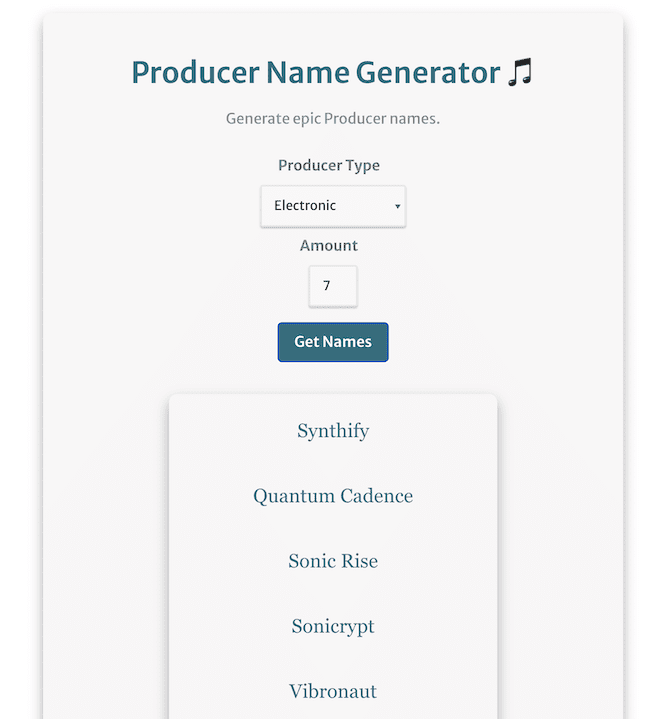
Producer Name Generator 🎵
Generate epic Producer names.
How the Producer Name Generator Works
The Producer Name Generator runs on genre-specific word banks rather than a single universal list. Each genre has its own vocabulary patterns. Hip-hop, for example, draws from sharp percussive single-syllables and “DJ ___,” “Young ___,” or “Lil ___” prefixes. EDM, in contrast, leans toward stylized misspellings, single-word identities, and futuristic compounds. Trance, meanwhile, favors atmospheric, vaguely Greek or Latin-sounding constructions. The generator respects those conventions instead of mashing every genre into one homogenized blender.
Here’s how to actually use it:
- Select a genre filter (Hip-Hop, Rap, Electronic, EDM, Dubstep, Trance, Executive Producer, Hollywood, or Random).
- Choose how many names to generate in one batch (1–10).
- Click “Get Names” and read through the list.
- Repeat until you find two or three contenders worth testing.
One useful pattern: don’t grab the first name you like. Instead, generate 30–50 options across two or three sessions, write the standouts in a notes app, and let them sit for a day. The names that still feel right after 24 hours are the ones to actually consider claiming. Importantly, names that read great on the screen sometimes feel awkward when you say them out loud, so test pronunciation before you commit to anything permanent.
Why Your Producer Name Matters More Than You Think
Your producer name is the first thing a label, a manager, or a Spotify listener sees — usually before they hear a single second of audio. Spotify’s mobile interface cuts off artist names at roughly 25 characters. Instagram handles cap at 30. SoundCloud’s URL slug shapes search results, and TikTok favors short, taggable handles. Consequently, a name that looks clean within those constraints performs measurably better than one that gets truncated, hyphenated, or padded with numbers because the original was already taken.
Beyond logistics, the name is shorthand for everything you’re trying to be. “Deadmau5” telegraphs a specific kind of dark, wry electronic identity before Joel Zimmerman releases a single track. “Metro Boomin” sets up a young, trap-leaning producer brand that’s borne out by every beat tag. “Skrillex” — by Sonny Moore’s own admission, a recycled AOL screen name with no meaning — works because it’s odd, unpronounceable on first read, and impossible to forget once you hear it.
That last point matters. The most successful producer names in 2026 are not always the cleverest. Many are simply distinctive enough to win the search-and-recall war. In fact, several of the highest-streaming producer aliases on Spotify started as inside jokes, recycled gamer tags, or quick decisions made before a first SoundCloud upload. Distinctiveness, ultimately, beats polish.

Genres Built Into the Producer Name Generator
The Producer Name Generator covers nine genre filters, and each one optimizes for a different naming logic. Here’s what to expect from each setting:
Random
Pulls from every database. Best when you don’t yet know your genre or want maximum variety. Use this filter especially if you’re early enough in your career that you’re still figuring out your sound. Surprisingly, randomness often surfaces names you’d never have requested directly but immediately recognize as fitting once you see them in a list.
Hip-Hop and Rap
Names emphasize percussive consonants, “DJ” or “Lil” prefixes, and producer-tag-friendly phrasing. Specifically, the strongest hip-hop producer names work as both an artist alias AND a beat tag — meaning the name itself can be shouted on a track without sounding forced. The Rap filter overlaps but skews slightly toward names that sit cleanly in the rapper-meets-producer hybrid space, which is useful if you also rap or write your own bars.
Electronic and EDM
Electronic is broad — it pulls from house, techno, ambient, and electronica conventions. Often single-word, often stylized. EDM, by contrast, leans toward festival-sized names: all-caps potential, emotional impact, and crowd-chant-ability. “Skrillex! Skrillex! Skrillex!” works as a chant; “Adam Wiles” doesn’t. That difference, however small it seems on paper, decides whether the name survives a 30,000-person mainstage moment.
Dubstep and Trance
Dubstep names tend to be heavier and darker, referencing mechanical, robotic, or distorted imagery — names that match the wobble. Trance, conversely, leans atmospheric, often with mythological or celestial undertones. Think Tiësto, Above & Beyond, ATB. The two filters represent opposite ends of the electronic spectrum and produce noticeably different results, so pick the one that matches your actual sound rather than the one with cooler-looking words.
Executive Producer and Hollywood
The Executive Producer setting generates polished, professional-sounding names suited to credit lines on commercial work, hip-hop EPs you’re producing for someone else, or A&R-facing roles. Hollywood, meanwhile, leans cinematic — closer to a real-name format, suited to film and TV scoring, trailer music, and sync libraries. Both categories prioritize legitimacy over swagger.
How Famous Producers Actually Got Their Stage Names
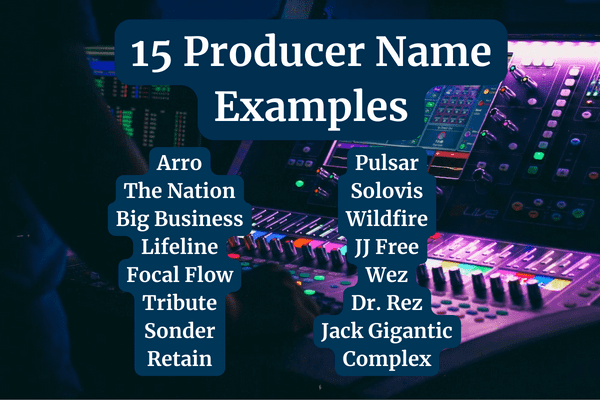
The naming process for legendary producers usually wasn’t strategic. Most stage names came from accidents, jokes, or recycled internet handles. That’s worth knowing because it takes some pressure off the search. Here are six origin stories that prove the point:
- Deadmau5 (Joel Zimmerman) — His computer started smelling, and when he opened it up he found a dead mouse inside. Friends started calling him “the dead mouse guy.” When he tried to register “Deadmouse” in an AOL chat room, the username was one character too long, so he swapped the “s” for a “5.” That’s the entire origin story.
- Skrillex (Sonny Moore) — Per Moore himself, the name is “a stupid old online AOL screen name” with no meaning. Previously he went by “Twipz.” There was no branding consultant and no marketing brief — just a recycled handle that happened to sound interesting.
- Calvin Harris (Adam Wiles) — Wiles told Shortlist magazine that his birth name sounded too plain for the soul-leaning music he was making early in his career. He picked “Calvin Harris” because it sounded racially ambiguous and let early listeners form their own assumptions. He has since said publicly that he prefers his real name in personal contexts, although the stage name remains.
- Metro Boomin (Leland Wayne) — “Metro” was a nickname coined by his mother during long drives between St. Louis and Atlanta. “Boomin” came later — it captures the bass-heavy 808 sound that defined his early production work. Today, the combination is one of the most valuable producer brands in hip-hop.
- Mike WiLL Made-It (Michael Williams II) — A self-descriptive tag that doubles as the producer alias. The capitalized “WiLL” is the visual hook; “Made-It” is the credit claim. Notably, the name itself is also the producer tag, which collapses two branding decisions into one.
- DJ Khaled (Khaled Mohamed Khaled) — Started as a radio DJ in Miami before crossing over into production. “DJ” was already attached because that was his actual job. Everything else — “We The Best,” “Another One,” the constant ad-libs — was layered on top of an already-set name.
What these origin stories share: distinctiveness over polish, a story behind the name (even a stupid one), and a willingness to keep the name through career pivots. Calvin Harris is the only one who openly disliked his stage name, and even he kept it. The lesson, ultimately, is that you don’t need a perfect name. You need a name you’ll commit to.
Tips for Picking a Producer Name That Sticks
Use these filters when evaluating any name from the Producer Name Generator. Each one rules out a common failure mode that costs newer producers months of momentum:
- Search-test it. Type the name into Spotify, Apple Music, SoundCloud, Instagram, TikTok, and Google. If there’s already a producer with the exact name putting out music in your genre, skip it. If there’s only a small artist on a single platform, you can sometimes outrank them — but it’s an uphill climb.
- Say it three times out loud. If you stumble on the pronunciation, your fans will too. A name that’s hard to pronounce is hard to recommend, hard to shout in a crowd, and hard to tag on a track.
- Check it across handles. Reserve @yourname on Instagram, TikTok, X, YouTube, and SoundCloud the day you commit. Even if the .com is taken, owning the social handles matters more in 2026 than the domain name does.
- Length: 5–10 characters is the sweet spot. Long enough to be searchable, short enough to fit on a festival poster. Names over 12 characters get truncated almost everywhere.
- Avoid numbers and special characters where possible. Deadmau5 made the “5” work because the rest of the name is already weird. Most numeric substitutions, however, read as desperate fallbacks because “the username was taken.”
- Run a trademark check. Hit the USPTO TESS database before you commit. A name already trademarked in your genre is a name you’ll lose in court if you grow.
- Consider how it looks in lowercase, uppercase, and stylized forms. “metroboomin,” “METROBOOMIN,” and “Metro Boomin” all need to look intentional. Names that only work in one case fail half the branding tests.
- Test the producer-tag potential. If you make beats, your name will likely become a tag — a one-second audio drop that plays at the start of your tracks. Names with rhythm, repetition, or a natural callout phrase tag better than awkward ones.
For an alternative angle on alias naming, the Call Sign Generator uses pilot and military naming conventions that occasionally produce great electronic-music handles. Songwriters working under their producer name might also find the Random Word Generator for Songs useful for brainstorming track titles to release under a freshly-claimed identity.

Legal and Branding Steps After You Use the Producer Name Generator
Once a name from the Producer Name Generator clears your gut check, here’s the order of operations to lock it down properly. Each step closes a specific door that an opportunistic third party could otherwise walk through:
Step 1 — Federal Trademark Search
Go to the USPTO’s TESS search at uspto.gov. Run the exact name and any close phonetic variants. If something comes up in International Class 41 (entertainment services) or Class 9 (recorded music), that’s a direct conflict and you should pick another name. Anything in unrelated classes — for example, a paint company or a restaurant — is usually fine but worth noting for completeness.
Step 2 — Domain and Handle Reservation
Same day you commit to the name. Register the .com if available; otherwise, grab a clean alternative — .fm and .live both work well for music brands. Lock down @handle on Instagram, TikTok, YouTube, X, SoundCloud, BandLab, and Spotify for Artists. Platforms operate first-come, first-served, so a 24-hour delay can cost you the handle permanently.
Step 3 — Distribution Profile
Set up a distributor (DistroKid, TuneCore, CD Baby, or Amuse) under your producer name before releasing anything. This binds the name to your release history, which becomes legal evidence of “use in commerce” if you later file for federal trademark protection. The earlier this paper trail starts, the stronger your position.
Step 4 — File Trademark When Revenue Justifies It
A federal trademark registration costs roughly $250–$350 per class plus attorney fees if you use one. Don’t bother filing until you’re actively earning revenue under the name and can document evidence of use. Filing too early often leaves you with an abandoned application and lost fees. Generally, a few thousand dollars in monthly streaming or sync revenue is the practical floor.
Step 5 — Build the Visual Brand
Logo, color palette, font system, photo direction. The name is a wrapper; the brand is everything inside. A producer name that looks cohesive across album art, IG grid, and YouTube thumbnails outperforms one that doesn’t, every time. Need a complementary side-project name? The Newsletter Name Generator works well if you plan to send a fan newsletter under your producer brand.
Producer Tags: The Audio Signature That Lives With Your Name
If you’re producing for other artists — beats for rappers, ghost production for vocalists, EDM tracks for festival sets — a producer tag is now a near-mandatory part of the brand. A producer tag is a short audio drop, usually 1–3 seconds, that plays at the start (or sometimes inside) a track to credit you. Tags originated in the 1990s when rappers ad-libbed their producers’ names over instrumentals, and the practice has since hardened into a professional norm.
The most iconic tags work because they’re instantly recognizable. For example:
- DJ Khaled — “We The Best Music” / “Another One” / “DJ Khaled”
- Metro Boomin — “If Young Metro don’t trust you, I’ma shoot you” (delivered by Future)
- Mike WiLL Made-It — Vocal stamp of his own name
- Mustard — “Mustard on the beat, ho!”
- Murda Beatz — “Murda on the beat, so it’s not nice”
Notice the pattern: most tags are voice-delivered, distinctive in tone, and short enough that they don’t interrupt the song. Some are recorded by the producer; many are recorded by a notable rapper as a co-sign. Either approach works, although a co-sign from an established artist accelerates credibility faster than a self-recorded tag.
If you pick a producer name from the generator with rhythm and natural cadence, you’re already halfway to a usable tag. Names that don’t have natural rhythm — three syllables of similar weight in a row, for example — make harder tags. Test it: can you imagine someone saying your name in a way that’s punchy, memorable, and doesn’t sound forced? If yes, the name has tag potential. If no, consider another option from the next batch.
FAQs About the Producer Name Generator
Are the names from the Producer Name Generator unique?
Names are pulled from a curated word bank and combined into thousands of possible permutations. However, uniqueness in the broader market depends entirely on you. Always run any candidate through Spotify, Instagram, and the USPTO TESS database before committing. The generator is a starting point; due diligence is non-negotiable.
Can I use a name from the generator commercially?
Yes. Names produced by the tool are not copyrighted to the site, and you can use any result as your own producer alias. Once you start using a name in commerce, you build common-law trademark rights in the geographic regions where you operate, regardless of where the name originated.
What’s the difference between a producer name and a DJ name?
Functionally, almost none in 2026. Producers DJ, DJs produce, and the lines blurred a decade ago. A “producer name” tends to imply someone who builds tracks; a “DJ name” implies someone who performs them live. Most successful electronic artists, however, do both under one name. The Producer Name Generator works equally well for either path.
Should my producer name match my real name?
Only if your real name is already memorable, distinctive, and search-friendly. “Pharrell Williams” works. “Adam Wiles” didn’t, which is why he became Calvin Harris. If your given name has heavy search competition or is hard to spell, a stage name is usually the right call. Otherwise, your real name is one less brand to build from scratch.
How many producer names should I generate before picking one?
Plan to review at least 30–50 results across multiple sessions before settling. Strong names rarely jump out on the first pass. The best workflow: generate 10 names, write down the standouts, come back the next day, repeat twice more, then pick from the names that still feel right after a week. Patience here saves a costly rebrand later.
Can I use the generator for executive producer or Hollywood-style names?
Yes — both filters are built in. The Executive Producer setting leans toward polished, professional names suited to credit lines on commercial releases or A&R roles. The Hollywood filter, meanwhile, generates names with a cinematic feel for film/TV scoring, trailer music, or sync library work.
Other Naming Tools You Might Want
If you’re building a full creative identity beyond the producer alias itself, several related tools on the site cover adjacent naming territory. The Drag Name Generator works well for performers who want a stage name with character and theatrical flair. The Call Sign Generator generates Top Gun-style aviator handles, which surprisingly often translate into great electronic music aliases. For producers who run a side hustle of writing or content, the Newsletter Name Generator can name your fan newsletter, and the Random Word Generator for Songs is useful when you’ve got the producer name locked but need help titling tracks under it.