Looking for a quick, accurate gender generator that does more than spit out random labels? Our gender generator pulls from a curated list of more than 50 gender identities — including widely-used terms like non-binary and agender, plus narrower identities like demigirl, bigender, and aporagender — and shows you what each one actually means in one line. Whether you’re researching identities for yourself, building characters for a novel or RPG, or simply curious about the language people use in 2026, this tool gives you a starting point in a single click.
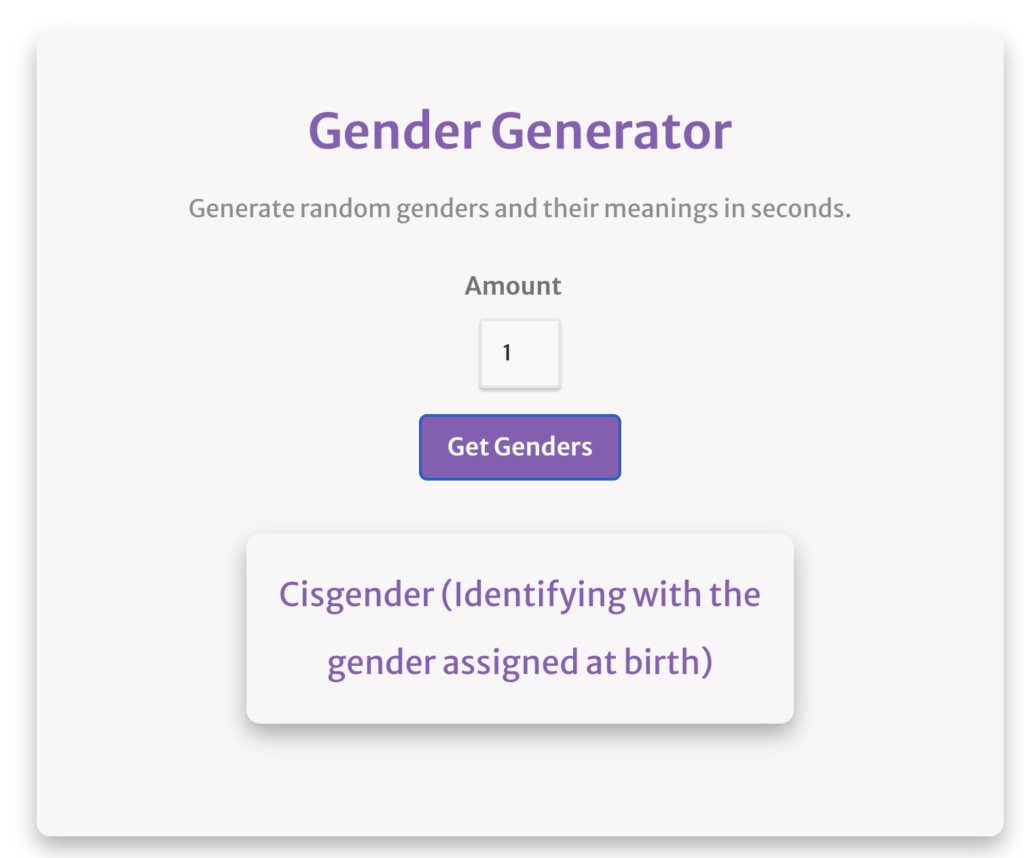
Gender Generator
Generate random genders and their meanings in seconds.
How the Gender Generator Works
The gender generator is built on a curated list of gender identities sourced from glossaries published by major LGBTQ+ organizations, including the Human Rights Campaign, The Trevor Project, and the Nonbinary Wiki. Each entry includes the identity name and a single-sentence definition that explains what it means in plain language. When you click the button, the tool shuffles that list and returns one or more entries at random.
You can choose how many results you want — typically anywhere from one to ten at a time. Additionally, results are weighted toward inclusion rather than rarity: well-established identities like male, female, non-binary, and agender appear alongside narrower terms like demiflux, neutrois, and xenogender, so you see the full spread of how people describe gender today rather than only the most common labels.
One thing to keep in mind: a generator can introduce you to a term, but it cannot tell you what fits. Therefore, if you’re using this gender generator for personal exploration, treat each result as a vocabulary word to look up further, not a verdict. For fiction writers, the same applies in reverse — pulling a label is the start of building a character, not the finish.
Why a Gender Generator Is Useful in 2026
The vocabulary around gender has expanded faster in the last decade than in the previous century. Specifically, Google Trends data shows that searches for non-binary, gender-fluid, and gender-neutral have multiplied many times over since 2014, and new terms continue to enter common usage every year. As a result, even people who are reasonably plugged in often run into identities they’ve never heard before.
That’s where a gender generator earns its keep. Rather than scrolling through a 30-entry glossary alphabetically, you get one term at a time with a short, accurate definition — which is much closer to how vocabulary actually sticks. In fact, encountering a single new word in context tends to lodge it in memory better than skimming a long list and remembering nothing.
The tool is also genuinely useful for writers and game designers. Notably, modern fiction has moved well past the assumption that every character is a cisgender man or woman, and readers increasingly notice when a cast lacks even passing diversity. A gender generator gives you a starting point — not a finished character, but a label to build outward from.

The Most Common Gender Identities the Generator Includes
About a dozen identities account for the majority of how people describe gender outside the binary. These are the terms you’re most likely to encounter in everyday life, in news coverage, and on social profiles. Furthermore, these are the terms our gender generator weights most heavily because they’re the most likely to be useful as a starting point.
Non-Binary
Non-binary is an umbrella term for any gender identity that isn’t strictly male or female. Some non-binary people feel partially male and partially female; others feel like neither; and still others feel that their gender shifts. Importantly, non-binary is not synonymous with androgynous — many non-binary people present in ways that read as conventionally masculine or feminine. The shorthand “enby,” derived from the letters N-B, is widely used, although some prefer the full term.
Agender
Agender people experience an absence of gender rather than a particular gender. Notably, this differs from non-binary in a subtle but real way: a non-binary person typically has a sense of gender that simply isn’t male or female, while an agender person tends to describe gender as not applying to them at all. The terms genderless, gender-free, and ungendered are sometimes used interchangeably with agender.
Genderfluid
Genderfluid describes someone whose gender shifts across time. The shifts can be daily, weekly, or seasonal — there’s no fixed cadence. For example, a genderfluid person might feel masculine on a Monday, more feminine on a Wednesday, and entirely outside the binary by the weekend. Pronouns sometimes shift along with gender; sometimes they don’t. As a result, asking is always reasonable.
Bigender
Bigender people identify with two distinct genders, either simultaneously or alternating between them. Crucially, this is different from genderfluid: a bigender person’s two genders are typically fixed (man and woman, woman and non-binary, etc.), while a genderfluid person’s gender can land anywhere on the spectrum at any time. The two genders also don’t have to be present in equal measure.
Demigender (Demiboy and Demigirl)
Demigender identities involve a partial connection to a gender. Specifically, a demiboy partially identifies as a man but doesn’t fully align with being male; a demigirl is the same in the other direction. The remainder of the identity might be non-binary, agender, or simply unlabeled. Demigender is especially common among people who used to identify firmly with a binary gender and have since loosened that connection without rejecting it entirely.
Genderqueer
Genderqueer is one of the older umbrella terms — it predates “non-binary” in mainstream usage by roughly two decades. Many genderqueer people describe their identity as a deliberate rejection of fixed gender categories rather than a specific position within them. Today, the term is still widely used, particularly by people who came of age in the 1990s and 2000s and feel the political weight of the word matters.
Two-Spirit
Two-Spirit is a culture-specific identity used by some Indigenous people in North America to describe a person who embodies both masculine and feminine spirits. Importantly, Two-Spirit is not a generic synonym for non-binary — it carries specific cultural and ceremonial meaning, and using it requires being part of an Indigenous community where the term applies. The gender generator includes it for completeness, but it’s not a label outsiders should adopt.
Less-Common Identities the Gender Generator Surfaces
Beyond the dozen or so widely-known identities, our gender generator includes a long tail of narrower terms. Most people will never encounter these in casual conversation, however they show up in academic writing, in online communities, and increasingly in fiction. Here are several worth knowing.
- Aporagender — a non-binary gender identity that is distinct from male, female, and any combination of the two. Notably, the prefix “apora-” comes from the Greek for “separate,” signaling something genuinely apart from the binary rather than between or outside it.
- Neutrois — closely related to agender, but specifically describes a feeling of gender neutrality. Some neutrois people pursue a physical presentation that minimizes gendered features.
- Demiflux — a combination of demigender and genderflux: one part of the identity stays stable, while the other fluctuates in intensity over time.
- Xenogender — an umbrella for identities that describe gender through metaphor rather than the masculine-feminine spectrum. For instance, someone might describe their gender in terms of color, texture, or natural phenomena. Although the term is sometimes mocked online, the underlying concept is older than the label.
- Maverique — coined in 2014, this describes a gender identity independent of male, female, and neutral. It’s a deliberate alternative to “non-binary” for people who feel even that umbrella implies a relationship to the binary.
- Polygender — identifying with multiple genders simultaneously, typically more than the two of bigender. The genders can be related or disparate.
- Androgyne — a gender identity that combines masculine and feminine qualities. Although the word is sometimes used to describe presentation alone, it’s also a gender identity in its own right.
- Transmasculine and Transfeminine — describe a person’s direction of identification rather than a specific gender. Specifically, transmasculine people identify more with masculinity than the gender they were assigned at birth; transfeminine is the reverse. Both can be binary or non-binary.
One more honest caveat: the boundaries between these terms are not always crisp. Many people use two or three labels together because no single one captures their experience. The gender generator can introduce you to the vocabulary, but the people using these words are usually the best authority on what they mean to them.
Using the Gender Generator for Character Creation
One of the fastest-growing uses for a gender generator is fiction writing — novels, short stories, tabletop RPGs, video game design, and webcomic worldbuilding. In particular, modern audiences notice when a cast is monolithically cisgender, and a generator gives you a quick way to break out of default assumptions when you’re spinning up secondary characters.
That said, a label alone isn’t a character. A useful workflow looks something like this:
- Generate the gender first, then the rest. If you start with personality and then bolt on a gender, you tend to write the gender as a costume. Conversely, starting from the gender forces you to consider how it shapes the character’s history, the language they use about themselves, and how the world treats them.
- Pair the result with a name generator that fits your setting. For fantasy, our Elden Ring name generator or Dragonborn name generator pairs well; for sci-fi, the Twi’lek name generator works. For modern realism, our non-binary name generator is built specifically to pair with non-binary characters.
- Decide how the world treats this gender. Is your setting one where gender is a non-issue, where it’s politically charged, where it’s tied to magical systems, or something else? The same identity reads very differently in a future utopia versus a Victorian-era stand-in.
- Write the pronouns into the prose immediately. Don’t bury them in a character sheet you’ll forget to check. Specifically, if a character uses they/them, get a paragraph of working draft using they/them pronouns before you move on. This catches the rhythm before you’ve written a chapter.
Tabletop RPG game masters, in particular, find the gender generator useful for one-shot NPCs. When a player walks into a tavern and asks who’s behind the bar, you have ten seconds to invent a person — a quick roll on the gender generator, paired with a quick name roll, gives you the bones of someone the player will remember.
Using the Gender Generator for Personal Exploration
For people questioning their own gender, the appeal of a gender generator is different. Specifically, it’s not random in the way a slot machine is random — it’s structured serendipity. You get exposed to terms you might not have searched for, and sometimes a label you’d never considered turns out to fit.
A few things to keep in mind if you’re exploring:
- You don’t have to commit. Trying on a label for a week, in private, is a perfectly normal part of the process. Therefore, the generator is low-stakes by design — nothing about clicking it requires you to tell anyone.
- Multiple labels are okay. Many people land on a stack like “non-binary, transmasculine, demiboy” rather than a single word. Furthermore, that’s not indecisive — gender is genuinely multidimensional, and one word rarely captures everything.
- The label can change later. People update their identity vocabulary as they learn more or as their experience shifts. In fact, that’s normal and not a sign that the previous label was wrong.
- Talk to a real human if it gets heavy. A gender generator is a vocabulary tool. If you find yourself wrestling with significant distress, an LGBTQ+ community center, a peer support line like the Trevor Project, or a gender-affirming therapist will help in a way no website can.
A Quick Pronoun Guide That Pairs With the Gender Generator
Gender and pronouns aren’t the same thing — plenty of non-binary people use he/him or she/her, and plenty of cisgender people use they/them in writing — but they often travel together. Below is a quick reference to the pronoun sets you’re most likely to encounter alongside the identities the gender generator surfaces.
| Pronoun Set | Subject | Object | Possessive | Example |
|---|---|---|---|---|
| He/him | he | him | his | He brought his book. |
| She/her | she | her | her | She brought her book. |
| They/them (singular) | they | them | their | They brought their book. |
| Xe/xem | xe | xem | xyr | Xe brought xyr book. |
| Ze/zir | ze | zir | zir | Ze brought zir book. |
| It/its (when used affirmingly) | it | it | its | It brought its book. |
One nuance worth noting: it/its as a personal pronoun is sometimes used affirmingly by people whose identity makes the conventional sets feel wrong, however it’s also been used as a slur historically. Therefore, only use it for someone who has explicitly asked for it.
Tips for Choosing a Gender That Actually Fits
Whether you’re using the gender generator for yourself or for a character, the same principles apply once you’ve got a result on screen. The label is a starting point; the work is figuring out whether it actually describes the person.
- Read the definition twice. Many gender terms have closely-related neighbors that mean different things. Particularly, demigender, demifluid, and demiflux are easy to conflate, and you’ll get a more accurate fit if you read past the headline.
- Sit with it for a few days. First impressions of a label are often distorted by either novelty or self-doubt. Therefore, give yourself a week before deciding whether it fits.
- Try the pronouns silently. Read a paragraph about yourself (or your character) using the pronouns associated with the identity. Notably, your reaction to that exercise tells you more than any quiz.
- Note what you wish were different. If a label is 80% right and 20% wrong, the 20% is data — usually it points you toward a more specific identity. For example, “non-binary but I want to be read as masculine sometimes” might point toward demiboy or transmasculine non-binary.
- Don’t outsource the decision. Friends, partners, online communities, and gender generators can all introduce you to vocabulary, however none of them can tell you what fits. That’s always your call.
Frequently Asked Questions About the Gender Generator
How accurate is the gender generator?
The gender generator is accurate in the sense that every entry on its list is a real, documented gender identity with a definition pulled from established LGBTQ+ glossaries. However, it’s not predictive — it can’t tell you what your gender is, and it doesn’t claim to. The randomness is structured exposure, not a diagnostic test.
How many gender identities are in the gender generator?
The current list includes more than 50 distinct identities, ranging from binary genders (male, female) through widely-known non-binary identities (agender, genderfluid, demigirl) to narrower terms (aporagender, maverique, demiflux). The list is reviewed periodically and updated when new terms enter mainstream usage.
Can I use the gender generator results for fiction?
Yes — character creation is one of the most common use cases. Authors, screenwriters, tabletop RPG game masters, and video game designers regularly use the tool to break out of default assumptions when designing background characters. Just remember that a label alone doesn’t carry character; you’ll need to do the work of building the person around it.
What’s the difference between this gender generator and a sexuality generator?
Gender is who you are; sexuality is who you’re attracted to. They’re related but independent — a gay man, a straight non-binary person, and a bisexual woman are all valid combinations. This tool focuses specifically on gender identity. If you want a sexuality breakdown, you’d want a different generator that covers terms like asexual, pansexual, demisexual, and so on.
Is it appropriate to use the gender generator if I’m cisgender?
Absolutely. Most cisgender users come to the tool out of curiosity, for fiction writing, or to better understand the language used by friends and family. Learning the vocabulary is a meaningful step toward being a thoughtful ally, and there’s nothing inappropriate about that. The one rule of thumb: don’t claim an identity you don’t actually hold, particularly culturally specific ones like Two-Spirit.
Why does the gender generator include rare terms most people haven’t heard of?
Because some of the most useful information comes from terms that haven’t gone mainstream yet. Specifically, identities like aporagender, maverique, and demiflux describe distinct experiences that the more common labels gloss over. Including them gives users — especially writers and people doing personal exploration — access to vocabulary they probably wouldn’t find on their own.
Related Generators on CalculatorWise
If you’re using this gender generator for character creation or self-exploration, several other tools on the site pair naturally with it:
- Non-Binary Name Generator — gender-neutral first names, ideal for non-binary characters or for anyone trying out a new name.
- Trans Name Generator — masculine, feminine, and gender-neutral names organized for people exploring a new name post-transition.
- Drag Name Generator — punny, theatrical drag names for performers and characters.
- Drag King Name Generator — masculine drag personas, the counterpart to drag queen names.
Updated for 2026 with current terminology, an expanded list of less-common identities, and a refreshed pronoun guide. The gender generator works on desktop and mobile and requires no signup, no email, and no installation.