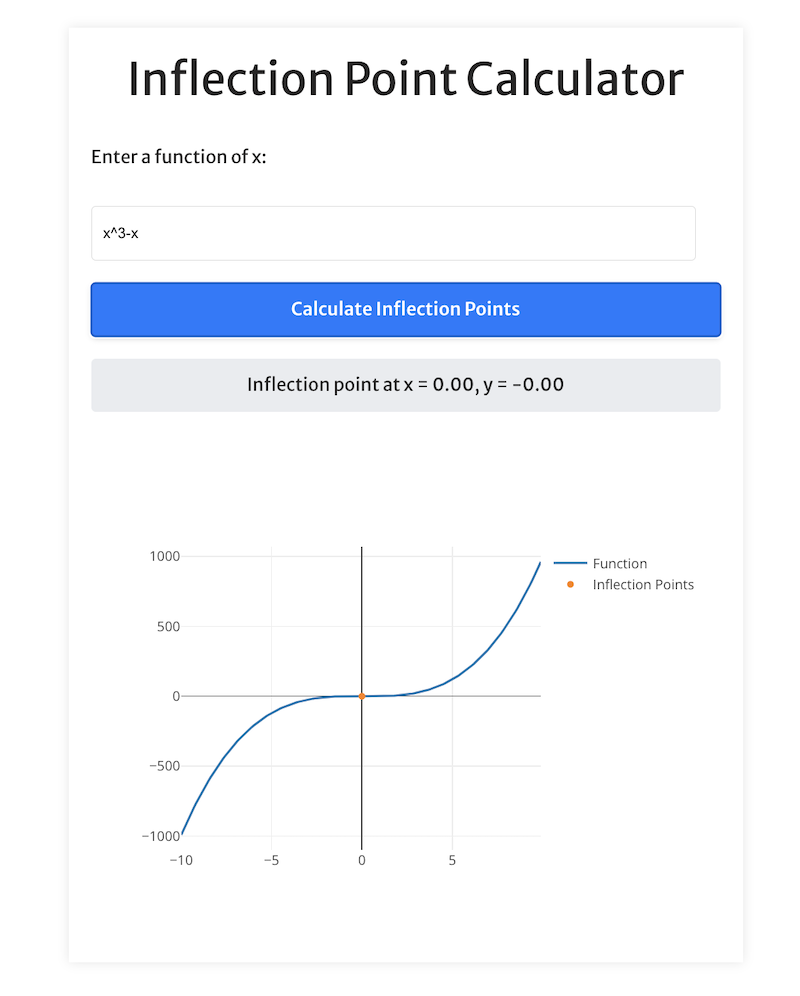
Looking for an inflection point calculator that handles polynomials, rational functions, trig expressions, and exponentials without forcing you to compute the second derivative by hand? This inflection point calculator runs the full algorithm for you. Specifically, it parses your function, computes f′(x), then f″(x), solves f″(x) = 0, and verifies a true sign change before reporting each inflection point with its (x, y) coordinates. Furthermore, it plots the curve right alongside the answer, so you can confirm the concavity flip visually rather than trusting a number on its own.
Inflection Point Calculator
Enter a function of x:
What Is an Inflection Point and Why Does It Matter?
An inflection point is the exact location on a curve where concavity flips. In other words, concave-up becomes concave-down or vice versa. Mathematically, it is any x-value where the second derivative f″(x) changes sign. The classic textbook example is f(x) = x³. For x < 0, the curve bows downward; for x > 0, it bows upward; right at x = 0, the curve flattens momentarily and switches direction of curvature. Therefore, x = 0 is the inflection point.
However, many students and even practicing engineers confuse inflection points with maximums, minimums, or zeros of the function. They are not the same thing. Specifically, a maximum is where f′(x) = 0 and the curve peaks. A minimum is where f′(x) = 0 and the curve troughs. Meanwhile, an inflection point is where f″(x) changes sign, and the function itself can be increasing, decreasing, positive, or negative there. The two derivatives describe genuinely different behaviors.
Moreover, the practical importance of inflection points goes far beyond calculus homework. In physics, an inflection point on a position-time graph marks where acceleration reverses. In epidemiology, the inflection point on a cumulative-cases curve marks the moment new infections start to slow. In product growth, an inflection point on a user-acquisition graph is where a startup tips from steady linear growth into compounding adoption — the famous “hockey stick.” Identifying that point early can be worth millions in funding decisions.
How the Inflection Point Calculator Solves Your Function
Behind the simple input box, the inflection point calculator runs a four-step routine that mirrors the standard calculus procedure. However, it does the work symbolically and instantly.
Step 1 — Parse the Function
First, the calculator reads your input and converts it into a symbolic expression. It accepts the standard notation you would type into any algebra system: caret (^) for exponents, asterisk (*) for multiplication, parentheses for grouping, and named functions like sin, cos, tan, ln, exp, and sqrt. For example, the polynomial x^3 – 6*x^2 + 11*x – 6 is parsed as a cubic. Similarly, sin(x) – x/3 is treated as a transcendental expression.
Step 2 — Compute the First and Second Derivatives
Next, the engine differentiates symbolically. For x³ − 6x² + 11x − 6, it returns f′(x) = 3x² − 12x + 11 and f″(x) = 6x − 12. For trigonometric or exponential inputs, it applies the chain rule, product rule, and quotient rule recursively until it reaches a closed-form second derivative. Notably, this is the step that takes humans the longest by hand and is the most error-prone.
Step 3 — Solve f″(x) = 0 for Candidate Points
Once the second derivative is in hand, the calculator solves f″(x) = 0 for every real root. Importantly, these roots are candidate inflection points, not confirmed ones. This is a critical distinction we will return to later. For 6x − 12 = 0, the only candidate is x = 2.
Step 4 — Verify a Sign Change in Concavity
Finally, the inflection point calculator tests f″(x) on either side of each candidate. If f″(x) is negative just left of the candidate and positive just right (or vice versa), concavity actually flips, and the candidate becomes a confirmed inflection point. Conversely, if the sign does not change, the candidate is rejected. This last verification is the step most students skip and most online calculators handle lazily. However, it is the only thing that distinguishes a genuine inflection point from a fake one.
After verification, the calculator computes f(x) at each confirmed inflection point so it can report the full (x, y) coordinate. Subsequently, it plots the curve so you can see the concavity flip visually.

How to Use the Inflection Point Calculator: Input Tips and Notation
The inflection point calculator accepts most standard math notation. However, a few formatting habits will save you from cryptic error messages.
For exponents, use the caret: type x^3 not x³. Multiplication needs an explicit asterisk: 2*x not 2x. Implicit multiplication trips up many parsers. Additionally, parentheses must always balance, and trig and log functions require their argument in parentheses: sin(x) not sin x.
When working with rational functions, wrap the entire numerator and denominator: (x^2 + 1)/(x – 3), not x^2 + 1/x – 3 (which the parser reads as x² + 1/x − 3, a different function entirely). For natural log, type ln(x); for the natural exponential, type exp(x) or e^x. Scientific notation works as 1.5e-3 for 0.0015. Pi is written pi and Euler’s number is e.
If you enter a function and the calculator returns no inflection points, that is a real answer. In fact, many functions genuinely have none. For example, a parabola like x² has no inflection point because its second derivative is the constant 2, which never changes sign. Similarly, a purely linear function like 3x + 5 has zero second derivative everywhere and thus no inflection point either.
Worked Examples From the Inflection Point Calculator
Three examples of increasing difficulty show exactly what the inflection point calculator returns and how to interpret the output.
Example 1 — A Simple Cubic
Input: f(x) = x³ − 3x² + 2. The first derivative is f′(x) = 3x² − 6x. The second derivative is f″(x) = 6x − 6. Setting 6x − 6 = 0 gives x = 1. At x = 0.5, f″(0.5) = −3 (concave down). Meanwhile, at x = 1.5, f″(1.5) = 3 (concave up). Concavity flips, so this is a confirmed inflection point. Substituting back, f(1) = 1 − 3 + 2 = 0. The calculator reports the inflection point at (1, 0).
Example 2 — A Quartic With Two Inflection Points
Input: f(x) = x⁴ − 6x² + 4. The second derivative is f″(x) = 12x² − 12. Solving 12x² − 12 = 0 gives x = ±1. At x = 0, f″(0) = −12 (concave down). However, at x = ±2, f″(±2) = 36 (concave up). Both candidates show sign changes. Substituting, f(1) = −1 and f(−1) = −1. Therefore, the calculator reports two inflection points: (−1, −1) and (1, −1). Interestingly, this kind of symmetric quartic always produces inflection points at equal distances from the y-axis.
Example 3 — A Trigonometric Function
Input: f(x) = sin(x) on [0, 2π]. The first derivative is f′(x) = cos(x). The second derivative is f″(x) = −sin(x). Solving −sin(x) = 0 in this interval gives x = 0, π, and 2π. At each of these points, concavity actually flips. Specifically, f″ is negative on (0, π) and positive on (π, 2π). The inflection points are therefore (0, 0), (π, 0), and (2π, 0). Trig functions remind you that inflection points often appear in regular patterns. For sine, that pattern is every multiple of π.
Three Common Mistakes the Inflection Point Calculator Helps You Avoid
Even strong calculus students make the same handful of errors when finding inflection points by hand. The inflection point calculator catches each one automatically. However, knowing the traps helps you trust the output and write better solutions on exams.
Mistake 1 — Assuming f″(x) = 0 Always Means an Inflection Point
This is the most famous trap. Consider f(x) = x⁴. The second derivative is 12x², which equals zero at x = 0. However, f″(x) is positive on both sides of zero — concavity never flips. Specifically, the curve stays concave up everywhere. Therefore, x = 0 is not an inflection point, despite f″(0) = 0. Mathematicians call this an “undulation point” rather than an inflection. The inflection point calculator runs the sign-change test specifically to catch this kind of false positive.
Mistake 2 — Ignoring Points Where f″(x) Is Undefined
Inflection points can occur where the second derivative does not exist, not just where it equals zero. For example, the cube root function f(x) = x^(1/3) has an inflection point at x = 0 even though f″(0) is undefined. Concavity still flips there. Consequently, a robust inflection point calculator checks for both conditions: f″(x) = 0 and f″(x) undefined. By contrast, lazier calculators only solve the equation and miss this whole category.
Mistake 3 — Forgetting to Compute the y-Coordinate
Students often report inflection points as just an x-value. Technically, an inflection point is a point on the curve. Therefore, it has both coordinates. The calculator always returns (x, y) so you have the complete answer for graphing and writing up solutions. Additionally, the y-coordinate matters for any application where you care about the actual height of the curve at the inflection — for example, the population size at an epidemic’s turning point.
Real-World Inflection Points: Where the Math Actually Matters
The inflection point calculator is built for calculus class. However, the concept it solves is one of the most useful in applied math.
In a startup’s user-growth curve, the inflection point is the moment growth shifts from linear to compounding. Investors call this “hitting hockey stick” and use the inflection point as a proxy for product-market fit. Spotting it early lets a founder time a fundraise around the curve’s bend rather than its peak. Furthermore, the same idea applies in reverse: a downward inflection point on revenue is an early warning that a business is decelerating before it becomes obvious in the headline numbers. If you are building growth models, our forecasting calculator pairs naturally with this tool.
In epidemiology, the cumulative-infections curve during an outbreak is initially concave up — each day’s new cases exceed the last. Subsequently, the inflection point marks the transition into concave-down territory, where new cases are still growing but at a slowing rate. Public health officials watched this point obsessively during the 2020 pandemic. By 2026, modern surveillance dashboards now flag inflection points automatically using rolling second-derivative estimates.
In structural engineering, a beam under load develops a deflection curve, and its inflection points reveal where bending stress reverses. Engineers place reinforcement at these points specifically because the steel transitions from tension to compression at the inflection. Notably, missing one in a long-span design is a structural error that can cost millions to retrofit.
In macroeconomics, an inflection point on a yield-curve surface can signal a regime change in monetary policy. Traders model these surfaces with cubic splines and look for second-derivative sign flips to predict Fed pivots before official announcements. For all these applications, the math is identical to the homework problem. Specifically, find the second derivative, solve for zero, verify the sign change. The inflection point calculator just removes the algebraic friction so you can spend more time interpreting the result.
Inflection Point Calculator vs. Manual Method: When to Use Each
The inflection point calculator is fast and accurate. However, it is not a replacement for understanding the underlying calculus. Each approach has a place, and the smartest workflow uses both.
Use manual computation when you are learning the second-derivative test for the first time, when the function is simple enough that pencil-and-paper takes under a minute, or when you need to show your work on an exam. The act of computing f″(x) by hand cements the differentiation rules in long-term memory. In particular, this builds the intuition you need to spot inflection points visually on graphs.
Conversely, use the inflection point calculator when the function is too complex to differentiate quickly, when you need to verify a manual answer before submitting, when you are working with empirical data or a fitted curve, or when you simply need the answer fast for a real-world problem. Additionally, the calculator is invaluable for sanity-checking spline fits and regression curves where the algebra would otherwise take an hour.
The most productive workflow combines both methods. First, solve the problem manually. Then, plug it into the inflection point calculator to verify. If the answers match, you have confirmed your method. However, if they disagree, you have caught either a calculation error or a misunderstanding — and you will learn from the disagreement. Ultimately, this is how working mathematicians and engineers actually use computer algebra systems: as a verification layer, not a replacement for thinking.
Inflection Point Calculator FAQ
What does an inflection point calculator do?
An inflection point calculator finds the exact x-coordinates (and y-coordinates) on a function’s graph where the curve switches from concave-up to concave-down or vice versa. Specifically, it does this by computing the function’s second derivative, solving for where that derivative equals zero or is undefined, and verifying that the sign of the second derivative actually changes across each candidate. Then it plots the result so you can see the concavity flip visually.
Can the inflection point calculator handle trigonometric and exponential functions?
Yes. Type sin(x), cos(x), tan(x), exp(x), or ln(x) and the calculator differentiates them symbolically. For periodic functions like sin(x), expect multiple inflection points spaced regularly across the domain. Similarly, for exponentials and logarithms, expect at most one inflection point because their second derivatives never change sign on their natural domain.
Why did the inflection point calculator return no answer?
Three possibilities exist. First, your function genuinely has no inflection points — parabolas and lines never do. Second, the second derivative is constant and never changes sign. Third, your input contained a syntax error. Try simplifying the input or wrapping rational expressions in parentheses. Specifically, double-check that all parentheses balance and that you used asterisks for multiplication.
Is every solution to f″(x) = 0 an inflection point?
No. Setting the second derivative to zero produces candidate points. However, a genuine inflection point requires the second derivative to actually change sign across that point. The classic counterexample is f(x) = x⁴ at x = 0, where f″(0) = 0 but concavity does not flip. Therefore, always run the sign-change test.
Do inflection points always occur at integer x-values?
No. Clean integer answers are a coincidence of textbook problems designed for tidy numbers. In fact, real-world inflection points often land at irrational values like x = √2 or x = π/3. The inflection point calculator returns decimal approximations to four places by default. Furthermore, for empirical data fitted to a polynomial, the inflection point is almost guaranteed to be irrational.
How are inflection points different from maxima and minima?
Maxima and minima are where f′(x) = 0 — the curve peaks or troughs. By contrast, inflection points are where f″(x) changes sign — the curve switches concavity. A function can have an inflection point at any value of f, including values where the function is increasing or decreasing, positive or negative. In particular, the cubic f(x) = x³ has an inflection point at x = 0, but no maximum or minimum anywhere.
Related Calculators on CalculatorWise
For more calculus and analysis tools, explore these related calculators:
- Forecasting Calculator — project growth curves and identify their inflection points in business and finance contexts.
- Arrow Speed Calculator — a kinematics tool whose underlying drag equations exhibit inflection behavior at terminal velocity.
- Audiobook Speed Calculator — convert listening time and playback rate, useful when reasoning about cumulative-progress curves.
- Reading Time Calculator — estimate reading time and pace, another applied use of rate-of-change reasoning.
- Number to Words Converter — handy when writing up math solutions in essay form.
For external study material, Khan Academy’s section on analyzing the second derivative to find inflection points is the gold-standard free resource. Additionally, Paul’s Online Math Notes covers the shape of a graph and concavity in deeper detail for advanced students.