
Random State Generator
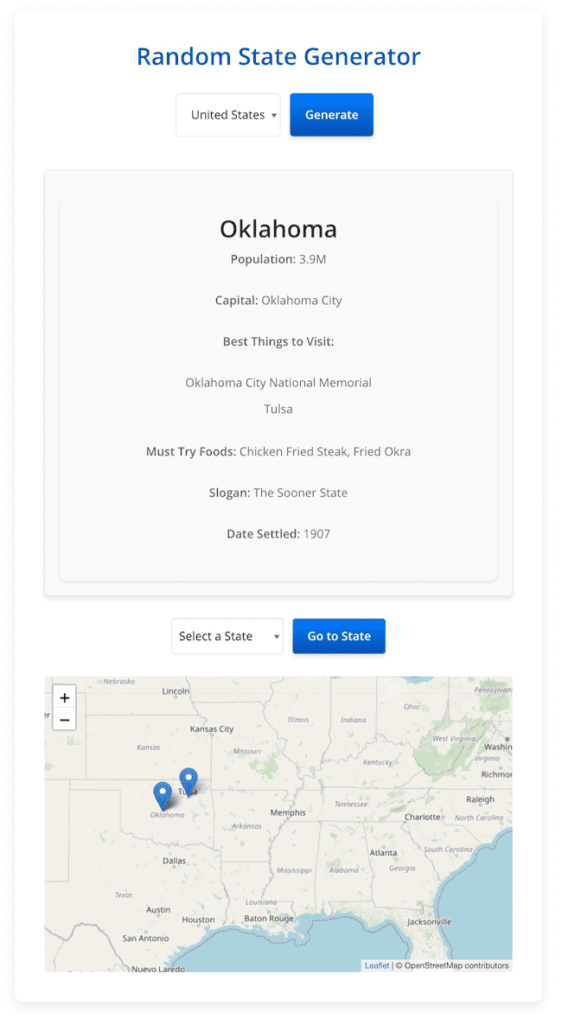
This random state generator picks one of the 50 US states (plus all 13 Canadian provinces and territories and 8 Australian states/territories) using an evenly-weighted random draw, then loads a profile card with the capital, population, year of statehood, state slogan, must-try local foods, and three travel ideas you can act on. Most state pickers stop at the name. This one keeps going so you can actually use the result — for a road-trip target, a geography lesson, a content prompt, or a bar-trivia round.
Below the tool you’ll find a regional framework for narrowing the draw, a comparison with wheel-style pickers, classroom and travel-planning playbooks, and a FAQ that answers the questions people actually ask before they spin.
What the Random State Generator Does Differently
Most “spin a state” tools online return a name and that’s it. Therefore, you get “Nebraska” — and then you’re back to Google searching for what to do with that. This random state generator is built around the assumption that you picked a random state for a reason: you want to learn something, plan something, or build something around the result.
So every draw returns seven structured fields:
- Capital city — the seat of state government, useful for trivia and quick orientation.
- Population — current resident count, helpful for understanding scale (Wyoming’s ~580K vs. California’s ~39M is a different trip).
- Date of statehood or settlement — historical context that shapes the culture you’ll encounter.
- Official state slogan or motto — a one-line snapshot of how the state markets itself.
- Best things to do — three to five concrete activities pulled from the state’s marquee experiences.
- Must-try local foods — regional dishes you’d be missing if you only ate at chains.
- Top travel ideas — itinerary starting points for a long weekend or a deeper trip.
Additionally, every result is anchored to a map view so you can see exactly where the state sits relative to its neighbors. For people who didn’t grow up memorizing US geography, that’s the difference between a useful prompt and a meaningless word.

How the Random State Generator Picks Each Result
Under the hood, this random state generator uses JavaScript’s Math.random() function to select an index from the active state list. Because the list is loaded once and every state holds exactly one slot, every state has the same probability of being drawn — 1 in 50 for the United States, 1 in 13 for Canada, and 1 in 8 for Australia.
That matters for two reasons. First, it means a “random state generator” that secretly weights popular states (California, New York, Texas) is doing something different from this one. Second, it means each spin is independent — you can land on the same state twice in a row, and that’s not a bug. It’s how true random selection works. Specifically, the probability of any two consecutive draws matching is 1 in 50, the same as the probability of drawing any single state.
If you want to avoid repeats — say, you’re building a 50-states-in-50-weeks travel series — toggle the “no repeats” option (where available) or simply keep a list of already-drawn states and reroll until you get a new one. Many users approach the tool this way for long-running projects.
Why Pseudo-Random Is Random Enough
Technically, JavaScript’s pseudo-random number generator isn’t cryptographically random — it’s deterministic from a hidden seed. However, for the purpose of “pick a state,” it’s indistinguishable from true randomness. The distribution is uniform across millions of draws, and no human eye can detect the pattern. Cryptographic randomness only matters when you’re protecting something like a password or a lottery; for picking a state to visit, pseudo-random is the right tool for the job.
When to Use a Random State Generator
People reach for this kind of tool for surprisingly varied reasons. Generally, the requests fall into five categories.
- Travel decision fatigue. You have a long weekend free, no plans, and “just pick somewhere” feels impossible. A random draw cuts through the paralysis.
- Geography practice. Teachers and students use it to drill state capitals, regions, and basic facts without working through the alphabet.
- Content creation. Bloggers, YouTubers, and TikTokers running “I cooked food from a random state” or “every state ranked” series need a fair way to pick the next entry.
- Worldbuilding. Writers setting a story in the US who don’t want to default to New York or California use it to land on somewhere unexpected, then research that location specifically.
- Trivia and party games. “Name three things from this state” is an easy, scalable round that works for kids and adults alike.
Each use case shapes how you should run the generator. For example, travel planners often want to filter by region first (you can’t fly to Hawaii on a three-day weekend from Chicago). Teachers, on the other hand, may want full random draws across all 50 states for fair coverage. The tool supports both modes.
Picking Random States by Region with the Random State Generator
Sometimes a fully random draw isn’t what you want. If you’re picking a state to visit and you live in Atlanta, getting “Alaska” isn’t useful. Therefore, it helps to mentally split the country into the four Census Bureau regions and decide which one fits your constraints first.
The Four US Regions at a Glance
- Northeast (9 states): Maine, New Hampshire, Vermont, Massachusetts, Rhode Island, Connecticut, New York, New Jersey, Pennsylvania. Dense, walkable cities; oldest US history; fall foliage; Atlantic seafood.
- South (16 states + DC): Delaware, Maryland, Virginia, West Virginia, North Carolina, South Carolina, Georgia, Florida, Kentucky, Tennessee, Alabama, Mississippi, Arkansas, Louisiana, Oklahoma, Texas. Warm-weather travel; barbecue and Cajun cuisine; civil-rights history; major theme-park hubs.
- Midwest (12 states): Ohio, Indiana, Illinois, Michigan, Wisconsin, Minnesota, Iowa, Missouri, North Dakota, South Dakota, Nebraska, Kansas. Lakes, agriculture, sports culture, and the country’s most underrated food scenes (Detroit pizza, St. Louis BBQ, Wisconsin cheese).
- West (13 states): Montana, Idaho, Wyoming, Colorado, New Mexico, Arizona, Utah, Nevada, California, Oregon, Washington, Alaska, Hawaii. National parks, mountain ranges, deserts, and Pacific coastline.
Once you’ve picked a region, run the generator within that subset. As a result, every result is one you can realistically reach. The same logic applies to Canada (Atlantic, Central, Prairie, West Coast, North) and Australia (mainland east, mainland west, central, Tasmania).

Random State Generator vs. Wheel Pickers and Spinners
If you’ve searched for this kind of tool before, you’ve probably seen wheel-style pickers — a big spinning circle divided into 50 slices, with a pointer that lands on one. They’re visually fun, especially for a classroom. However, they have three real downsides compared with a structured random state generator.
- Limited information. Wheel pickers usually return just the state name. You still have to look up the capital, population, and what to do there.
- Slower repeat draws. Each spin animation takes 3–5 seconds. If you’re picking 10 states for a trivia round, that’s nearly a minute of waiting.
- Visual bias toward certain slices. Wheels can feel like they “favor” the slice closest to the starting position, even when the math says otherwise. A direct random pick removes that perception.
That said, wheels do one thing well — drama. Rolling a die or pressing a button is functional; spinning a wheel feels like a moment. For a classroom or a party, that matters. The right answer depends on what you’re optimizing for. Specifically, if you want speed and information, use this tool. If you want spectacle, a wheel is fine.
Travel Planning With the Random State Generator
Here’s a concrete playbook for using this picker as a travel-decision tool. Travel paralysis is real — research from decision-science journals consistently shows that people offered too many options end up choosing nothing. Constraint, paradoxically, makes choosing easier. A random draw is the most extreme constraint of all.
Step 1 — Set Your Hard Constraints First
Before you spin, write down what’s actually fixed: budget, dates, who’s coming, total travel time. If you’ve got a $400 flight budget and three days off, a coast-to-coast result like Hawaii is not viable. So narrow the picker to a region that fits your constraints first, then spin.
Step 2 — Spin and Commit
This is the hard part. Once the result lands, give yourself a “two reroll” rule and stop. Three rerolls means you didn’t actually want a random pick — you wanted a particular state and were hoping the dice would deliver it. Just go.
Step 3 — Build the Trip From the Tool’s Output
The tool’s profile card already gives you a head start: capital, population scale, must-try foods, and a few activity ideas. Treat that as your starting framework. From there, layer in:
- One or two of the suggested foods (book a restaurant, not a chain).
- One landmark or activity from the “things to do” list as your anchor day.
- One drive or hike that’s local-known but not in the top tourist guides — Reddit’s r/[StateName] and local subreddits are excellent for this.
Companies like Pack Up + Go have built an entire business around random destination travel for people who want the experience but don’t want to plan it themselves. This tool is the DIY version of the same idea — same surprise, no $1,000+ booking fee.
Classroom Uses for the Random State Generator
Teachers from grades 3 through 12 use a state randomizer to keep US geography lessons unpredictable. Predictable lessons get tuned out; unpredictable ones don’t. Here are five activities that scale across age groups.
- State of the Day. Spin once each morning. Students get five minutes to find the capital and one fact, then share. By the end of the school year, you’ve covered most of the map without a textbook.
- Random research project. Each student spins their own assigned state and produces a one-page profile by Friday. Removes the “I want California” lobbying problem.
- 50-State Bracket. Spin two states; students debate which would be a better place to live, vacation, or start a business. A vote decides the winner. Run as a single-elimination bracket over a unit.
- Geography trivia round. Spin five states; students must order them by population, alphabet, or year of statehood. Self-checking with the generator’s output card.
- Cross-curricular writing. Spin one state; students write a short story set there using at least three location-specific details. Naturally, the generator’s “things to do” and “local foods” fields are usable as story hooks.
Content Creator Use Cases
If you run a YouTube channel, TikTok, or blog, “random state” formats are evergreen. They generate built-in series structure (50 episodes guaranteed) and remove the producer’s burden of picking each topic. Some formats that have worked in 2026:
- “I cooked one dish from each state.” The generator’s “must-try local foods” field becomes your menu.
- “Reviewing every state’s official song.” Niche, but state songs vary wildly in quality, and the bracket structure writes itself.
- “Designing a travel poster for every state.” Pair the generator with the “things to do” list as visual prompts.
- “Reacting to each state’s flag.” Quick-format videos that don’t require travel.
- “AITA but it’s about state stereotypes.” Comedy format using the slogan and one regional fact as a punchline.
The shared insight is that randomness is a creative constraint. Forcing yourself to do an episode about North Dakota when you’d never have picked it voluntarily produces stronger work than picking the safe states every time.
Tips for Getting the Most Out of Each Spin
- Read the slogan first. “Live Free or Die” tells you something about New Hampshire’s culture that takes a paragraph to explain otherwise.
- Compare population to your home state. It instantly contextualizes the rest of the data — “10x smaller than mine” reframes everything.
- Pick one food, one activity, one fact. Don’t try to absorb everything; pick one thing from each category and you’ll actually remember the state a year later.
- Run the generator before you research. If you read about a state first and then spin, you’ll subconsciously want it to land there. Spin blind.
- Don’t reroll dramatic results. Hawaii or Alaska feel “too big” compared with Iowa, but those big results are usually the most memorable trips.
Random State Generator FAQ
Is this random state generator truly random?
Yes, in every practical sense. It uses JavaScript’s Math.random() to pick an index from a uniformly weighted array of states. Each US state has a 1-in-50 chance on every spin, with no hidden weighting toward popular states. Technically, the algorithm is pseudo-random rather than cryptographically random — but for picking a state to visit or quiz, the distinction doesn’t matter.
Can the random state generator pick the same state twice in a row?
Yes — and that’s how true random selection works. The probability is 1 in 50 each spin, regardless of what came before. If you’re running a series and need unique results, keep your own list of drawn states and reroll any duplicates.
Does the generator include Washington DC, Puerto Rico, or US territories?
The default list covers the 50 states only. DC and the territories (Puerto Rico, Guam, US Virgin Islands, American Samoa, Northern Mariana Islands) aren’t included by default because they aren’t states. However, that’s a popular request and we’re working on a “states + DC + territories” toggle for a future update.
Why does the random state generator also have Canada and Australia?
Both countries use “states” or “provinces” as their primary subdivisions, and a chunk of our users are looking for them too. Canada has 10 provinces and 3 territories; Australia has 6 states and 2 mainland territories. Including them turns the tool into a more general subnational picker without changing how the core US generator works.
Can I use this random state generator for a giveaway or contest?
For a casual social-media giveaway, yes. For anything legally binding (a sweepstakes governed by state law, for example), use a dedicated certified-random tool that produces a verifiable seed and audit trail. Pseudo-random is fine for fun; it’s not a substitute for an audited drawing.
How accurate is the data on each state?
Population figures use the most recent US Census Bureau estimates available at update time. Capital, statehood date, and slogan come from official state government sources. Foods and “things to do” are curated rather than algorithmically generated, so they reflect editorial picks rather than every option — but every entry has been cross-checked against current local sources as of 2026.
Related Tools on CalculatorWise
If you like the random state generator, these other randomizers and pickers on the site work well alongside it:
- Random Date Generator — pair with a state to plan a “random place, random date” weekend.
- Random Day of the Week Generator — useful for “any random Tuesday in any random state” prompts.
- Random Month Generator — adds seasonal context to a random state pick.
- Random Year Generator — for historical writing prompts (“a random state in a random year”).
- Blank Slate Word Generator — another fast randomizer that pairs well with party games.