Need a name that fits a fictional brother, a real-life sibling, or a sweet nickname you can text instead of his actual name? The brother name generator on this page does all three. There are actually two tools below — a Random Brother Name Generator with thousands of authentic first names sorted by style and era, and a Personalized Brother Name Generator that builds custom nicknames around your own name. Pick the one that matches your situation, or use both back-to-back to compare results.
Random Brother Name Generator
Generate awesome and unique brother names for your creative projects in seconds.
Personalized Brother Name Generator
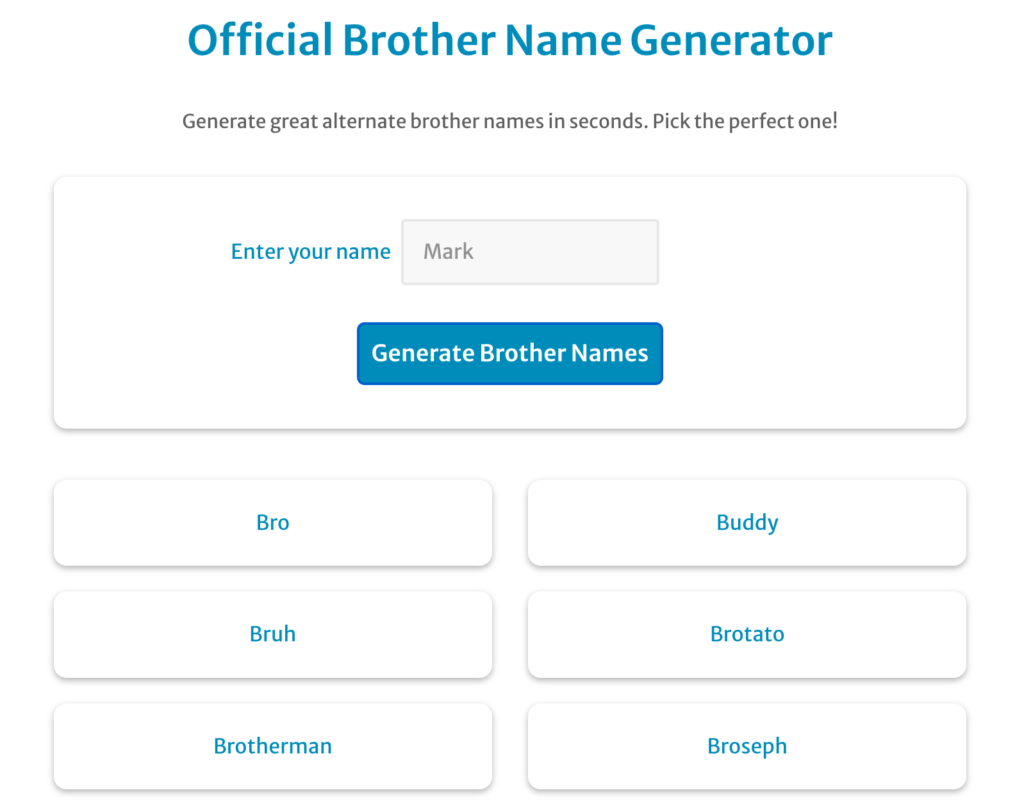
Generate great alternate brother names in seconds. Pick the perfect one!
How the Brother Name Generator Works (and Which One to Use)
This page actually has two separate tools stacked one above the other, and they solve very different problems. The Random version pulls from a curated library of more than 1,000 male first names — classic, modern, vintage, biblical, fantasy, and international — and outputs whatever quantity you request. Therefore, it works best when you need a believable name for a character, a baby brother on the way, or a roleplay profile. The Personalized version does something different: it takes nickname patterns (rhymes, suffix swaps, affectionate diminutives, and joke-style epithets) and builds them around an input. As a result, it produces names you’d actually call a real person, not names you’d put on a birth certificate.
For example, type “Jack” into the personalized tool and you might get back “Jacky-Boy,” “Big J,” “Captain Jack,” or “Jackal.” Type nothing into the random tool and you’ll get something like “Theo, Caspian, Hugo, Bennett, Marcus.” Both lean on real-name patterns rather than gibberish, which means the output sounds plausible the moment you read it. Importantly, neither version repeats the same name twice in a single batch, so you can hit Generate over and over without burning through your screen with duplicates.
If you’re genuinely undecided about which to use, the rule of thumb is simple. Use the random tool when the name will appear in writing — a novel, screenplay, video game character sheet, D&D campaign, or birth announcement. Use the personalized version when the name will be spoken out loud — texting your brother, captioning a Reels post, signing a birthday card, or coming up with a roast for a wedding toast.
Best Brother Names of 2026 (Sorted by Style)
Naming trends shift quickly, and what’s popular for brothers in 2026 leans toward shorter, vintage-leaning, vowel-heavy names rather than the long Victorian revivals that dominated the late 2010s. Furthermore, parents (and writers) are increasingly mixing eras inside the same family — pairing a “Theo” with an “Atlas,” or an “Eli” with a “Cassius” — because aesthetic coherence matters more than strict matching. Below are the categories the Random Brother Name Generator pulls from most heavily this year, with a representative sample from each.
Short and Crisp (one or two syllables)
These dominate U.S. and U.K. baby-name charts in 2026 because they read as confident without being old-fashioned. Specifically: Finn, Milo, Otto, Cole, Reid, Knox, Beau, Jude, Wyatt, Rhett, Cruz, Theo, Ace, Kai, Levi, Ezra, Zeke, Bode, Tate, Hugo, Arlo, Wells, Banks. Notably, single-syllable names like Knox and Reid pair beautifully with two-syllable siblings — Knox and Otto, Reid and Theo, Cole and Milo.
Vintage Revival
Names your great-grandfather had that are coming back hard: August, Atticus, Bennett, Calvin, Dean, Edmund, Felix, Frederick, Henry, Jasper, Linus, Mortimer, Nathaniel, Oliver, Percy, Roman, Silas, Theodore, Vincent, Walter, Wendell. These work especially well in historical fiction or for anyone targeting a “old soul” character vibe.
Biblical & Spiritual
Surprisingly resilient across decades and cultures: Asher, Caleb, Elijah, Enoch, Ezekiel, Gideon, Isaac, Isaiah, Jeremiah, Jonah, Josiah, Levi, Malachi, Micah, Moses, Nehemiah, Noah, Obadiah, Reuben, Samuel, Saul, Tobias, Zachariah. In fact, six of the top 25 U.S. boy names in 2026 are biblical, so this category is the most “safe” option in any naming context.
Fantasy and Mythic
Pulled from Greek myth, Norse legend, and high fantasy: Achilles, Apollo, Atlas, Caspian, Cassius, Cyrus, Damon, Draco, Emrys, Galen, Hadrian, Hector, Helios, Idris, Jago, Kael, Leander, Loki, Magnus, Odin, Orion, Percival, Phoenix, Rune, Soren, Theron, Thor, Ulric, Wulf, Zephyr. These are the workhorses of fantasy fiction — every brother set in modern fantasy YA seems to draw from this well.
International (non-Anglo)
For characters and brothers from non-English-speaking backgrounds, or for parents wanting a name that travels: Akira, Amir, Andrei, Arjun, Bashir, Diego, Dmitri, Eitan, Hamza, Hiroshi, Ibrahim, Joaquin, Kenji, Kiran, Luka, Mateo, Mikhail, Mohammed, Nikolai, Omar, Rafael, Ravi, Santiago, Tariq, Yuki, Yusuf. The tool weighs these by region so you can request, say, “two Latin American names” and not get a Greek and a Japanese result side by side.
How to Pair Brother Names That Sound Like Family
One of the trickiest parts of naming siblings — fictional or real — is finding names that feel related without sounding like a marketing campaign. Generally, “matchy-matchy” names (Lily and Lilly, or Aiden, Jaden, and Caden) get mocked in baby-name circles, while names with no obvious connection at all (Bartholomew and Brody) feel like they belong to different families. The sweet spot is what name researchers call aesthetic coherence: names that clearly come from the same sensibility without performing their relationship out loud.
Five Brother Name Generator Pairing Strategies That Actually Work
Based on naming-industry research and a review of how successful authors handle sibling sets, these are the five reliable approaches:
- Same era, different sounds. Theo and Atlas. Both feel modern-vintage, but no shared letters or rhythm. This is the safest pairing strategy.
- Shared origin, different feel. Caleb and Tobias. Both biblical, but one is short and the other elaborate. Adds variety without breaking thematic unity.
- Matched syllable count. Reid, Cole, and Knox (all one syllable) or Bennett, Sawyer, and Logan (all two syllables). Creates rhythm without rhyming.
- Hidden theme. Atlas, Orion, and Phoenix all reference the night sky, but a casual listener won’t catch it. The Phelps family’s Sebastian, Atticus, and Lawrence share a literary thread without being obvious.
- Anchor name plus complement. Pick one strong, traditional name (Henry, Edward, William) and pair it with a more unexpected sibling (Henry and Cassius, Edward and Wolf). Creates contrast without chaos.
What to avoid: starting both names with the same letter (Mike and Matt feel like a duo act), using two ultra-trendy names from the exact same year (Liam and Aiden will date the family), or pairing a wildly unusual name with a totally generic one (Zephyr and John makes John feel forgotten). Additionally, don’t overlook the last name — a flowing first name pairs awkwardly with a long surname, while a percussive first name balances a two-syllable surname well.
Iconic Fictional Brothers and What Their Names Reveal
If you’re using the brother name generator for fiction, it helps to study what already works. Specifically, the most memorable fictional brother names in modern storytelling share a few common patterns — and breaking them down shows you why a randomly generated “Theo and Marcus” tends to feel right while “Brad and Tyson” doesn’t.
Sam and Dean Winchester (Supernatural)
Both names are short, masculine, and slightly Americana — they could realistically belong to two truck-driving brothers from Kansas. However, Sam (a biblical reference, “to hear”) leans intellectual, while Dean (Old English, “valley”) leans tactile. The contrast is right there in the names before either character speaks. Furthermore, Eric Kripke has said in interviews that he chose names that wouldn’t pin the show to a decade, which is part of why Supernatural still casts well to new viewers in 2026.
The Weasley Brothers (Harry Potter)
J.K. Rowling gave seven Weasley children English literary names: Bill (William), Charlie, Percy, Fred, George, Ron (Ronald), and Ginny (Ginevra). Notably, the four older boys all have Plantagenet/medieval-king roots, while the twins get Hanoverian-era English-monarch names. As a result, the family reads as deeply, almost defiantly British — exactly the social signal Rowling needed for a working-class wizard family.
Thor and Loki (Marvel/Norse Myth)
Pure Norse mythology, but worth studying because the brothers’ names are phonologically opposite. Thor is hard, plosive, ends in a rolled “r.” Loki is soft, vowel-heavy, ends in a long “ee.” The names sonically dramatize the brothers’ personalities — and the brother name generator’s mythic category leans into this exact effect.
Sherlock and Mycroft Holmes
Conan Doyle picked two names that, in the 1880s, would have sounded equally bizarre to a London reader. Therefore, the names function as a flag: this family is unusual, eccentric, and operates outside Victorian norms. The lesson for your own writing: if you want a family to feel deliberately strange, give every brother an unusual name. If you want one brother to feel like the outsider, give the other brothers normal names and make him the outlier.
Cute and Meaningful Nicknames to Call Your Real Brother
Switching gears — if you landed here looking for a sweet, funny, or mildly insulting nickname for your actual brother, the Personalized Brother Name Generator above will produce dozens. However, the best nicknames usually come from real-life moments rather than algorithms, so here’s a framework for thinking about what makes a nickname stick.
The Four Categories of Brother Nicknames
- Affectionate diminutives. Bro, Bubba, Boo, Bud, Buddy, Champ, Dude, Kiddo, Pal, Squirt. Universal and warm. Best for younger brothers or playful older brothers.
- Inside-joke names. Names tied to a specific incident — Pizza Hands, The Senator, Sergeant Salt — that only the family understands. These are the highest-quality nicknames because they’re impossible to fake.
- Real-name spinoffs. Take his actual name and torque it: Michael becomes Mickey, Mike-Mike, Big Mike, Iron Mike, Mickey D, Sir Mikealot. Ninety percent of long-term nicknames started this way.
- Roast names. Affectionately mean — Goblin, Gremlin, Buzzkill, Walking ATM, Permit Patrol. Best reserved for brothers with thick skin and a sense of humor. Use sparingly.
The personalized tool weights its output across all four categories, so a single batch will typically include one affectionate, one diminutive, one real-name spinoff, and one roast. Ultimately, the goal is to give you four flavors to react to — you’ll feel which one fits within about two seconds of reading it.
Tips for Using the Brother Name Generator for Writers
Writers tend to over-use any name generator the same way — they hit Generate, scan the list, pick the first name that sounds cool, and move on. As a result, the name they choose often clashes with the character’s role, era, or social class three chapters later. Here’s how to use the brother name generator more strategically.
- Generate twenty, not five. The first names that come up tend to be the most generic. Furthermore, your brain has a strong recency bias — names twenty deep on the list often feel fresher because you haven’t been primed to expect them.
- Say each name out loud. Names that read fine on the page can sound terrible in dialogue. If you can’t yell “Get over here, [name]!” without laughing, it’s the wrong name.
- Check the era. A character born in 1955 should have a 1950s name. Use Social Security baby-name data (free, online, sortable by year) to confirm a generated name was actually being given to babies in your character’s birth year. The tool includes era-appropriate names but doesn’t filter automatically.
- Test against the antagonist. Heroes and villains shouldn’t share initials or rhythms. If your protagonist is “Kael” and your villain ends up as “Kane,” scrap one and re-roll.
- Lock the surname first. Generate the surname before the first name and the pairing tends to feel more natural. A “Bennett Whitlock” reads better than “Bennett Smith” — the longer surname earns the slightly elaborate first name.
- Use older brothers as anchors. If you’ve already named the older brother in the story, generate names that feel like they could share a household. The generator doesn’t know about the rest of your cast, so this part is on you.
- Don’t pick names you can’t pronounce. Readers who stumble over a name will pause every time they hit it on the page. Specifically, avoid names that beta readers consistently mispronounce — that’s a tell that the name is going to break the reader’s flow.
Bonus tip for D&D and tabletop players: generate three names per character and let the table vote during session zero. The tool is fast enough that you can name an entire NPC family in under a minute, which is exactly the kind of preparation that separates good DMs from great ones.
Building a Whole Family with the Brother Name Generator
Most brother sets in fiction don’t stop at two — fantasy series average three to five sons per noble house, and family sagas often have six or more. Therefore, the brother name generator can be paired with the related family-name tools on this site to build out an entire household in fifteen minutes.
Start with the parents (use the Mother Name Generator and Father Name Generator), confirm the sons through this brother generator, then add daughters with the Sister Name Generator. Finally, anchor the older generation with the Grandma Name Maker and Grandpa Name Generator, plus the Aunt Name Generator and Uncle Name Generator for the extended family.
The advantage of using the same family of generators is that they share name pools and pairing logic. As a result, a “Bennett” generated as a son will plausibly have a “Margaret” as a mother — both names fit the same vintage-revival aesthetic. By contrast, mixing tools across different sites tends to produce mismatched results because each tool was trained on different data.
Frequently Asked Questions About the Brother Name Generator
Is the brother name generator free to use?
Yes — both versions are completely free. There’s no signup, no captcha, no usage limit, and no watermark on the results. You can generate names as many times as you want and copy any of them straight into your manuscript, character sheet, or text message.
How many names does the brother name generator have?
The random tool pulls from a library of more than 1,000 male first names spanning classic, modern, vintage, biblical, fantasy, and international categories, updated periodically as naming trends shift. The personalized tool generates nicknames combinatorially, so the effective output is essentially unlimited — you’ll see thousands of unique combinations before any pattern repeats.
Can I use brother name generator results commercially?
Yes. Names themselves can’t be copyrighted, so anything the tool produces is yours to use in books, games, films, podcasts, business names, or any other commercial project without attribution. However, if you generate a name that happens to match a famous trademarked character (the tool avoids these, but it’s possible), do a quick trademark search before publishing.
What’s the best way to find brother names that go together?
Generate eight to ten names at once instead of two at a time. Then read them as a set, not individually. The pair that “sounds like family” will jump out — usually because they share an era, a syllable count, or a country of origin. If nothing in the batch works as a pair, regenerate; the second batch tends to feel more cohesive because you’ve already calibrated your taste against the first.
Does the generator work for half-brothers, step-brothers, or adopted brothers?
Absolutely — and this is one of the cases where you might actually want mismatched names. A half-brother raised in a different household plausibly has a name that doesn’t fit the rest of the sibling set, which can be a useful storytelling beat. For step-brothers, lean into deliberately different naming aesthetics (one classical, one modern) to signal the family’s different origins.
Can the brother name generator give me real names of real people?
The generator doesn’t pull from any database of real individuals — it combines first names from public naming data (which everyone shares with thousands of other people) without any last names attached. Therefore, while you’ll occasionally see a generated name that happens to match someone famous (a “Theo” or a “Marcus”), the tool isn’t producing or revealing identifying information.
Related Generators on CalculatorWise
- Sister Name Generator — the matching tool for finding names that pair with whatever brother name you just generated.
- Aunt Name Generator and Uncle Name Generator — for the extended family side characters every saga needs.
- Grandma Name Maker and Grandpa Name Generator — anchor the older generation with era-appropriate names.
- Dwarf Name Generator, Elden Ring Name Generator, and Hobbit Name Generator — when your brothers live in a fantasy world rather than a contemporary one.
Whether you needed a strong brother name for a character or a nickname that finally beats “bro,” the brother name generator above should have you covered. Hit Generate a few more times — the right name usually shows up somewhere in the third or fourth batch, once you’ve worked through the obvious candidates and started noticing the ones that actually fit.