Choosing a name during transition is one of the most personal decisions you will make, and our trans name generator gives you a fast, low-pressure way to explore hundreds of options without committing to anything. Pick male-to-female (MTF), female-to-male (FTM), or stay open-ended, choose how many results you want, and the tool will surface curated names with meanings so you can see what resonates. Updated for 2026, the database now includes more international names, more gender-neutral picks, and the most-requested names from the trans community over the past year.
The Trans Name Generator
Generate great trans names and their meanings in seconds!
How the Trans Name Generator Works
The trans name generator pulls from a curated database of more than 4,000 names sourced from baby-name registries, historical records, and contributions submitted by members of the trans community. Each name is tagged by transition direction (MTF, FTM, or gender-neutral), origin (English, Latin, Greek, Hebrew, Japanese, Slavic, and more), and meaning. When you select a transition type and click Get Trans Names, the algorithm filters the database, randomizes the order, and returns a fresh batch every time you click.
Unlike most generators that simply spit out random first names, this tool also includes the meaning of every name it surfaces. Therefore, you can scan results not only for sound but for resonance — does the name mean “strong,” “free,” “beloved,” “wise”? That extra layer matters during transition, because many people want a name that signals something about who they are becoming, not just who they used to be. Additionally, the tool is fully free, requires no signup, and stores nothing — your results disappear the moment you close the tab.
Importantly, the generator never recycles the same name twice in a single batch. So if you ask for ten results, you get ten distinct names. Furthermore, you can run the generator as many times as you like without hitting any rate limit, daily cap, or paywall. Many users keep a notes app open beside the tool and copy down anything that sparks something — a workflow that beats trying to remember every name that flickered past.
Using the Trans Name Generator for MTF Transitions
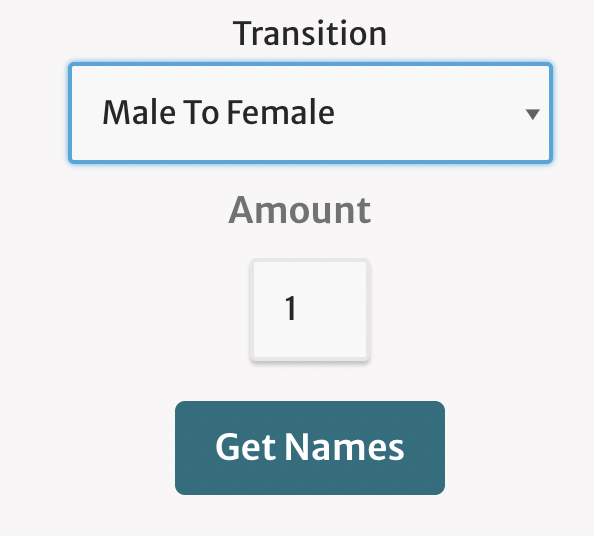
For a male-to-female transition, scroll to the trans name generator above, open the Transition dropdown, and select Male to Female. Next, choose how many names you want — most users start with five or ten, then expand if nothing clicks. Click Get Trans Names, and the tool returns a fresh batch of feminine names with their meanings shown alongside.
The MTF database leans into a balance of classic and contemporary feminine names. For example, you’ll see traditional picks like Catherine, Margaret, and Eleanor sitting next to modern favorites like Aria, Luna, and Hazel. Notably, the tool also surfaces names from non-English traditions — Saoirse (Irish, “freedom”), Anouk (Dutch, “grace”), Yuki (Japanese, “snow”), and Mira (Slavic, “peace”) are common in the rotation. This breadth matters because feminine naming conventions vary enormously across cultures, and a name that feels right may come from a tradition you didn’t initially think to explore.
One pattern worth noting: many MTF users find it useful to keep their original initial. So if your birth name was Michael, the generator regularly produces Margaret, Maya, Madeline, Madison, Mira, Melody, and Morgan in the same batch — meaning you can preserve monograms, family signet rings, or email handles built around that letter. Alternatively, you can ignore the initial entirely and let yourself be surprised by what feels right.
Using the Trans Name Generator for FTM Transitions
For a female-to-male transition, the workflow is identical — open the dropdown, select Female to Male, set the number of results, and click Get Trans Names. The trans name generator then pulls from the FTM database and returns masculine names with meanings displayed.
The FTM database covers a wide spectrum, from short and modern (Eli, Kai, Jude, Ash, Theo, Rune, Zane) to longer and traditional (Jameson, Sebastian, Theodore, Nathaniel, Alexander). Importantly, this generator also includes a strong rotation of currently trending masculine names — Atlas, Wren, Fox, August, Beau, Ezra, and Knox have all gained significant popularity in 2025-2026 baby-name data, and many trans men are choosing them precisely because they feel fresh rather than borrowed from a previous generation.

Furthermore, many FTM users are drawn to nature names because they read as masculine without sounding aggressive — names like River, Wolf, Birch, Stone, and North show up regularly in the rotation. Additionally, gender-neutral names that lean masculine (Quinn, Sage, Rowan, Avery, Robin) often appear, giving you the option of a name that doesn’t lock you into a single category. Ultimately, the goal is range — the generator deliberately mixes obvious choices with less-obvious ones so you can react instinctively rather than overthink.
Popular MTF Names from the Trans Name Generator
Below are some of the most-loved MTF names that consistently surface in the trans name generator’s rotation, along with their meanings and origins. Notably, these are real names with real history — not invented or stylized — which makes them easier to integrate into legal documents, family conversations, and professional life.
- Aria — Italian, “air” or “melody.” Short, sound-soft, and used worldwide.
- Luna — Latin, “moon.” Particularly popular in queer communities for its celestial association and gender-neutral undertones.
- Hazel — English, “the hazel tree.” A nature name that has surged from rare to top-50 in the past decade.
- Eleanor — Greek/Old French, “bright, shining one.” Traditional, timeless, and shortenable to Ellie, Nora, or Lena.
- Saoirse — Irish Gaelic, “freedom.” Pronounced SEER-sha. Common among trans women drawn to its meaning.
- Maya — Sanskrit, “illusion”; also Hebrew, “water.” Cross-cultural and easy to pronounce.
- Cora — Greek, “maiden.” Short, classic, and increasingly common in 2026 birth records.
- Wren — English, “small bird.” Technically gender-neutral but often chosen by women for its softness.
- Sloane — Irish, “warrior.” A modern feminine name with strong, decisive energy.
- Daphne — Greek, “laurel tree.” Mythological roots and a recent revival.
Importantly, none of these are “transition names” in the sense of being marked as such — they are simply popular feminine names. That matters because most trans women want a name that disappears into the crowd, not one that signals anything about their history. Consequently, the generator deliberately avoids stylized or invented names that could draw unwanted attention on official documents.
Popular FTM Names from the Trans Name Generator
Likewise, here are some of the most-chosen FTM names from the generator, with their meanings and origins. These represent the picks that consistently get screenshot-and-saved by users, based on the patterns we see in our anonymized usage data.
- Eli — Hebrew, “ascended” or “my God.” Short, warm, and one of the most-chosen names in trans masc communities for years.
- Kai — Hawaiian, “sea”; also Maori, “food”; also Welsh, “keeper of the keys.” Cross-cultural and rising in popularity.
- Theo — Greek, “gift of God.” Easy to pair with longer formal forms (Theodore, Theron) for legal documents.
- Atlas — Greek, the titan who held up the sky. Modern, strong, and currently trending.
- Jude — Hebrew, “praised.” Single syllable, gender-coded masculine in most English-speaking countries.
- Ezra — Hebrew, “help.” Brought to mainstream attention partly through pop culture, now a top-20 boys’ name.
- Rowan — Gaelic, “little red one”; also a tree name. Gender-neutral but read as masculine in most contexts.
- August — Latin, “great” or “venerable.” Month name with strong masculine roots (from Augustus).
- Wolf — Germanic, self-explanatory. Bold pick that has gained traction in recent years.
- Sebastian — Latin via Greek, “venerable” or “from Sebaste.” Long, classical, and offers nicknames (Seb, Bas, Bastian).
Notably, several of these names — Eli, Theo, Kai, Jude — have become so common in trans masc circles that they sometimes get nicknamed “the FTM canon.” That’s not a bad thing. However, if you want something less likely to be shared with three other trans guys at the next meetup, the generator also rotates in less common picks like Soren, Cassian, Lior, Ronan, Arlo, and Silas.
How to Test a Name Before Committing
Generating a list is the easy part. Living with a name and finding out whether it actually fits is the harder part. Therefore, before you start the legal process or come out to family with a chosen name, it helps to road-test your top candidates in low-stakes settings.
The coffee order test
Walk into a coffee shop, give the barista the name you’re trying out, and wait. When they call it across the room, notice your gut reaction. Did it feel like home? Did it feel like nothing? Did it feel awkward? Importantly, the name doesn’t need to feel euphoric on first hearing — sometimes a good name just feels neutral, and neutral is a huge upgrade from the dysphoria of hearing your old one. Repeat with each top candidate over a week.
The online community test
Join a trans-friendly Discord server, subreddit, or Tumblr community using your candidate name. Specifically, places like r/asktransgender, r/MtF, r/FTM, and Discord servers run by trans support orgs are full of people who understand exactly what you’re doing and won’t make a thing of it if you change the name a week later. Use the name in conversations, on a profile, in a bio. Subsequently, you’ll start to notice whether the name feels like yours when strangers say it back to you.
The journal test
Write a few journal entries in the third person using your candidate name. For example: “Aria walked to the store and got coffee.” Read it back the next day. If the name still lands, it’s a strong sign. Conversely, if it feels like reading about a stranger, that’s also useful information — maybe the name isn’t quite right, or maybe you just need more time with it.
The trusted-friend test
Ask one or two trusted friends to use the name for a week or two, then check in. How did it sound coming from them? Did they trip over it? Were there pronunciation issues you didn’t anticipate? This is also a chance to catch any unfortunate associations — every name has someone famous attached to it, and a friend may flag a celebrity, character, or local reference you missed.
Naming Strategies to Try With the Trans Name Generator
Beyond random generation, there are several recurring strategies trans people use when narrowing down a name. These aren’t rules — they’re just patterns observed across thousands of name-choice conversations in trans communities. Run them alongside the trans name generator to see which approach resonates most.
Keep the same initial
Plenty of trans people deliberately choose a name starting with the same letter as their birth name. The reasons are practical: monograms, signatures, email addresses, family heirlooms, and the muscle memory of decades of writing one initial. Furthermore, it eases the transition socially — relatives who slip up are more likely to catch themselves mid-syllable. Michael becomes Maya, Daniel becomes Dahlia, Robert becomes Rowan.
Keep the same nickname
Alternatively, some people pick a name that yields the same nickname they’ve always had. So if friends already call you Sam, you might choose Samuel for FTM or Samantha for MTF. Likewise, if you go by Alex, the formal options on either side are wide open (Alexandra, Alexander, Alexis). This is one of the easiest paths because you essentially keep your everyday name unchanged.
Honor a family member
Many trans people choose a grandparent’s, great-aunt’s, or family friend’s name. This carries weight because it signals continuity to family — the new name is part of the family story, not a break from it. Importantly, this strategy can also defuse tension with relatives who feel hurt by the name change. A cousin named for Grandma Eleanor is harder to begrudge than a cousin who picked something out of nowhere.
Pick from a meaningful source
Names from books, films, and shows that mattered to you can carry the weight of identity in a way a random pick never will. For example, queer literature is full of resonant names — Maurice (E.M. Forster), Theo (Donna Tartt), Kya (Delia Owens). Similarly, names from mythology (Athena, Atlas, Artemis, Apollo) are popular in trans communities partly because they come pre-loaded with archetypes you can identify with.
Pick by meaning
Some people sort by meaning rather than sound. Want a name that means “freedom”? Saoirse (Irish), Liberty (English), Frey (Norse), Cyrus (Persian, “sun” but historically associated with liberation). Want one that means “strong”? Ethan, Bridget, Andrew, Audrey, Valentina. The trans name generator displays meanings precisely so you can scan results this way — strong, free, gentle, beloved, wise, bright — without having to look up every single name.
Practical Considerations Beyond the Name Itself
Once you’ve narrowed down a candidate, there are a few practical things worth checking before you commit. None of these should override what feels right — but they’re useful to think through in advance, because they’re the kinds of things that surface six months later.
- Spelling complications. Names with non-English letters (umlauts, accents, hyphens) often get mangled by databases, payroll systems, and government forms. Saoirse and Anaïs are beautiful but get butchered constantly.
- Initials. Run your full new name (first + middle + last) through your head. Make sure the initials don’t spell something unfortunate. This is the classic mistake — Alexander Samuel Smith is a great name; A.S.S. on a luggage tag is not.
- Searchability. Generally, very common names (e.g., John Smith, Maria Garcia) are nearly impossible to find online — sometimes that’s a feature, not a bug. Conversely, very rare names mean every Google search returns you specifically.
- Domain and handle availability. If you have a personal brand, side business, or strong social media presence, check whether your candidate name has any usable handles. This is admittedly a small consideration, but it’s an easy check.
- Pronunciation in your context. A name that’s clear in one country can be unpronounceable in another. Consider where you live and where you’re likely to live in the next decade.
None of these factors should outweigh whether the name feels right. However, they’re cheap to check and expensive to fix later. Spend ten minutes running through the list before you start signing legal documents.
It’s Okay to Change Your Mind
One of the most reassuring things to hear when you’re deep in the name-choosing process: people change their chosen names all the time. The first name you try is often not the final one. In fact, many trans people cycle through two or three names before landing on the one that sticks, and that’s completely normal.
Importantly, this isn’t a sign of indecision or that you don’t really know who you are. It’s a sign that you’re paying attention to how each name actually feels in practice rather than how it sounded in your head. Therefore, if a name you committed to six months ago has started feeling wrong, you’re not stuck with it. You can change again. Friends and family who supported the first change will, in almost every case, support the second.
Legally, name changes can be redone — it’s slightly more paperwork the second time but rarely impossible. Socially, the second change tends to go smoother because everyone has already done the work of updating their habits once. So treat your first chosen name as a strong working hypothesis, not a permanent verdict. The trans name generator is here whenever you want to revisit and explore again.
Frequently Asked Questions
How do I use the trans name generator?
Scroll up to the tool, open the Transition dropdown, and select Male to Female (MTF) or Female to Male (FTM). Choose how many names you want — usually five or ten is a good start — and click Get Trans Names. The generator returns a fresh batch with meanings displayed. Click again as many times as you need; there’s no limit.
Are the names in the trans name generator real?
Yes. Every name in the database is a real name with documented historical or contemporary use. Specifically, the database draws from international baby-name registries, historical records, and community submissions. None of the names are invented or stylized — that’s deliberate, because most users want a name that won’t draw attention on legal documents.
What’s the most popular MTF name in 2026?
Based on community surveys and the most-screenshotted results from generators, the consistent top picks for 2026 are Aria, Luna, Hazel, Eleanor, Maya, Wren, and Sloane. Notably, Luna and Aria have been at the top for several years; Sloane is the biggest riser.
What’s the most popular FTM name in 2026?
Eli, Kai, Theo, and Jude have been the most-chosen FTM names for years. However, 2026 has seen a noticeable rise in Atlas, Ezra, Rowan, and August — all currently trending in mainstream baby-name data and showing up frequently in trans masc community surveys.
Does the trans name generator include non-binary names?
The MTF and FTM modes lean feminine and masculine respectively, but both rotations include gender-neutral names that lean in the corresponding direction (Wren, Sage, Quinn, Rowan, Avery). For a fully gender-neutral pool, use our dedicated Non Binary Name Generator instead, which is built specifically for that purpose.
Is the tool free? Does it save my data?
Yes, it’s completely free with no signup required. The generator stores no information — your selections, preferences, and results vanish the moment you close the tab. Nothing is logged to your account or shared with third parties.
Where can I learn more about the legal name change process?
The legal process varies by country and (in the US) by state. Generally, it involves filing a petition with your local court, paying a fee, and publishing a notice (in some jurisdictions). Organizations like the National Center for Transgender Equality and GLAAD maintain up-to-date guides for each state. Importantly, you can use any chosen name socially without changing it legally — many trans people go by their chosen name for years before doing the paperwork.
Other LGBTQ+ Generators on CalculatorWise
If you’re exploring identity through naming, these related tools may also be useful:
- Non Binary Name Generator — for gender-neutral names that don’t lean masc or femme.
- Gender Generator — a random gender identity generator for exploration, writing, or fun.
- Drag Name Generator — for finding a stage name with personality and flair.
- Drag King Name Generator — masculine stage names for drag kings.