Need a fast, reliable, and customizable way to generate random years? Use the Random Year Generator below to pull one year — or hundreds — from any range you set 💪
Random Year Generator
The Random Year Generator on this page picks a random year — or a long list of years — from any range you set, between 1 AD and the current calendar year. Whether you’re a novelist hunting for a story setting, a teacher building a history quiz, a tabletop game master placing a campaign on a timeline, or a developer needing realistic test data, this tool returns results instantly. Below, you’ll find a complete guide to using random years effectively in 2026, including the most evocative decades to draw from, worked examples, and the limitations you should know before relying on randomness alone.
How the Random Year Generator Works
The Random Year Generator uses a straightforward algorithm. When you click “Generate,” the tool selects a uniformly distributed integer between your starting year and ending year, inclusive. Every year in that range has an equal probability of being chosen. There’s no historical weighting, no cultural bias, and no preference for “famous” years — just pure randomness within the bounds you set.
By default, the range runs from 1 AD to the current year. However, you can narrow it dramatically. For example, set the range from 1985 to 1999 and you’ll only ever see years from the late 20th century. Alternatively, expand the range to cover the entire Common Era for true historical chaos — a single pull could land you in the Roman Empire, the Tang Dynasty, the European Renaissance, or last Tuesday.
You can also choose how many years to generate at once. Specifically, generate one for a single creative prompt, or generate fifty for a full timeline of fictional events. Furthermore, the results are independent of each other, so each year is drawn fresh and you can occasionally see duplicates if your range is small. That’s a property of true randomness, not a bug — and statisticians actually use it to verify the algorithm is working.
Behind the scenes, the generator pulls from your browser’s pseudorandom number generator. As a result, the output isn’t cryptographically secure, but it’s more than random enough for creative, educational, and casual use. Notably, the tool runs entirely in your browser — no years are ever sent to a server, so the results are private and instant.
Common Use Cases for the Random Year Generator
A random year generator sounds simple, but the use cases run deeper than most people realize. Here are the situations where users typically reach for one in 2026.
Historical Fiction Writing
Picking a year for a historical novel is one of the hardest decisions a writer makes. The decade you choose dictates clothing, technology, slang, social norms, political backdrop, and the kinds of conflict your characters can plausibly face. Many writers default to the same overworked eras — World War II, Tudor England, the American Civil War — because those periods feel safe. However, a random year generator deliberately disrupts that bias. For instance, if your generator returns 1684, you might find yourself researching the height of Louis XIV’s France, the founding of Pennsylvania, or the Genroku era in Edo-period Japan. As a result, the friction of an unfamiliar year forces fresher storytelling.
Tabletop RPG and Worldbuilding
Game masters use random year generators to build campaign timelines on the fly. Specifically, when a player asks “when did the dragon last attack this village?”, a quick generator pull gives an instant, unique answer. Worldbuilders also use random years to seed historical events for fictional cities, establishing founding dates, wars, plagues, and dynasty changes in seconds. Importantly, this approach prevents the lazy fallback of dating everything “a hundred years ago” or “in the time of the king’s grandfather.”
Trivia and Quiz Games
Pub quiz hosts and classroom teachers love random years. The format is endlessly flexible: “Name a Number One song from this year,” “Which U.S. president held office during this year?”, or “What technology was newly invented this year?” Because every year in the modern era has cultural anchors, a random year almost always produces a workable trivia round. Furthermore, you can stack multiple pulls to create elimination-style rounds — players who can’t name an event in the displayed year drop out.
Creative Writing Prompts
Beyond historical fiction, random years work as creative constraints. A short-story prompt of “set in 1953” or “set in 2087” forces a writer to commit to specifics — what cars, what music, what news. Notably, the further the year is from the present, the harder the prompt and the more interesting the writing. Many writing groups now use a weekly random year as their prompt of the week.
Software Testing and Data Generation
Developers use random year generators to create test data for date pickers, age calculators, copyright expiry logic, and database seed scripts. For instance, generating 500 random birth years between 1925 and 2010 produces a realistic distribution for testing pension or insurance calculators. Additionally, QA engineers use boundary-year pulls (1, 1900, 2099) to stress-test how their applications handle extreme date inputs.
Decision Games and Icebreakers
A random year can become a conversation starter. “If you could spend a week in this year, where would you go?” works for parties, classrooms, and team-building. Similarly, social media creators use random year prompts for “rate the year” videos and “describe this year in three words” challenges. The format took off on TikTok in 2024 and remains a steady source of viral short-form content in 2026.
Choosing a Smart Year Range
The default 1 AD to current-year range is rarely what you actually want. Before you click “Generate,” set a range that matches your purpose. Below are the ranges most users settle into, and why each works.
For Modern Pop Culture Trivia
Use 1950 to 2020. This window covers rock ‘n’ roll, the moon landing, the personal computer revolution, the rise of the internet, and most of the cultural touchstones a typical adult will recognize. Years before 1950 quickly run out of mass-media reference points, and years after 2020 may not have settled into “memorable” cultural status yet for the average player.
For Traditional Historical Fiction
Use 1800 to 1950. This is the sweet spot for traditional historical fiction. Specifically, the period covers the Industrial Revolution, the Victorian era, two World Wars, the Jazz Age, and early Hollywood. Records are dense enough to research deeply, but the era is distant enough to feel genuinely “historical” to a 2026 reader.
For Pre-Modern and Medieval Settings
Use 500 to 1500. The medieval and early modern range is perfect for fantasy worldbuilding, knight stories, plague-era thrillers, and Renaissance political dramas. Just remember that 500 to 1500 includes the Tang Dynasty, the Islamic Golden Age, the Khmer Empire, and Inca expansion — not only European history. Therefore, this range is also a goldmine for non-Eurocentric stories.
For Sci-Fi and Speculative Fiction
Use 2050 to 2200. This near-future range gives you enough room for plausible technological extrapolation without venturing into pure space opera. For deeper-space stories, expand to 2300 or beyond. Alternatively, if you want a setting close enough to feel like a warning, narrow to 2030 to 2060.
For Realistic Birthdate Generation
Use a range that produces realistic ages. If you’re generating birth years for adult characters in a story set in 2026, try 1955 to 2000 — that gives you ages 26 to 71, which is the bulk of the working-age adult population. For a children’s-book cast, try 2014 to 2018 instead.
For Pure Surprise
Use the full default range. Sometimes you want the surprise of a year you’ve never thought about — 274 AD, 612, 1391, 1837, 2814. The unfamiliarity is the point. Generally, this is the range writers default to when they want creativity-by-disruption rather than convenience.
The Most Evocative Decades to Pick a Year From
Some decades are simply richer for storytelling than others — packed with political upheaval, technological leaps, or cultural innovation. If you’re using the Random Year Generator to spark creativity, the following decades consistently produce the most usable results. Importantly, this is an opinionated list based on density of usable cultural reference points, not raw historical importance.
The 1920s (1920–1929)
The Roaring Twenties combine post-war exhaustion, jazz, Prohibition, the silent-to-talkie film transition, the Harlem Renaissance, and the run-up to the Great Depression. Few decades pack more cultural texture per year. Notably, every individual year in the 1920s has its own distinct flavor — 1925 (Gatsby’s publication) feels different from 1929 (the crash).
The 1960s (1960–1969)
Vietnam, the civil rights movement, the British Invasion, the Apollo program, the Summer of Love, and the assassinations of two Kennedys and Martin Luther King Jr. all happened in ten years. As a result, any specific year in the 1960s carries massive narrative weight. For 2026 readers raised on cultural nostalgia, the 1960s remains the highest-density decade in living memory.
The 1880s (1880–1889)
The late Victorian era is when the modern world recognizably begins. Specifically, electric light, the first skyscrapers, the Eiffel Tower, the rise of mass-circulation newspapers, and the colonial Scramble for Africa all hit in this decade. Furthermore, this is the era that produced Sherlock Holmes, Jack the Ripper, and the first phonograph recordings.
The 1990s (1990–1999)
For contemporary nostalgia, no decade is currently hotter. The 1990s produced the World Wide Web, the end of the Cold War, hip-hop’s mainstream takeover, and the cultural phenomenon of “alternative” anything. Particularly for readers in their 30s and 40s, a 1990s year is instantly evocative — and the decade is just far enough back to feel period-piece without requiring deep historical research.
The 2010s (2010–2019)
The decade of the smartphone, the streaming revolution, the rise of social media, and the global financial recovery. For stories rooted in recent memory, a 2010s year is unbeatable. Importantly, the decade also has a clear technological arc — early 2010s feels like a different world from late 2010s, and a randomly chosen year inside it is rarely ambiguous.
The 1430s (1430–1439)
Movable-type printing emerged from Mainz around 1440, the Hundred Years’ War was reaching its endgame, and the Italian Renaissance was hitting full stride. As a result, a year in the 1430s plants you at one of the most consequential turning points in human history — and one that’s drastically underused in fiction compared to later Tudor or Elizabethan periods.
The 750s (750–759)
The mid-eighth century is criminally underused in fiction. Specifically, the Abbasid Caliphate took power, the Tang Dynasty was at its cultural zenith, and the Carolingian Renaissance was beginning in Frankish Europe. There’s a global, civilization-spanning story here for any writer willing to claim it.
Worked Examples Using the Random Year Generator
To show how the Random Year Generator translates into actual creative work, here are five worked scenarios across different use cases.
Example 1: Picking a Year Between 2000 and 2020 for Trivia
Set the range from 2000 to 2020 and generate one year. Suppose it returns 2007. From there, you can build five trivia questions in under a minute: “What phone launched this year?” (the iPhone), “What financial crisis began this year?” (the subprime mortgage collapse), “Which Harry Potter book came out this year?” (Deathly Hallows), “Who won the World Series this year?” (the Boston Red Sox), and “What writers’ strike began in November this year?” (the WGA strike). Therefore, one click delivers an entire trivia round.
Example 2: Picking a Year Between 1985 and 1999 for a Short Story
You generate 1992. Now your protagonist’s world is bounded: pay phones, Blockbuster Video, the Bosnian War in the news, “Smells Like Teen Spirit” on the radio, the L.A. riots, and a Bill Clinton presidential campaign. Specifically, if you ground the story in three or four of those concrete details, the period feels lived-in rather than researched. Furthermore, your dialogue will naturally avoid anachronisms because you’ve anchored the year before writing a single line.
Example 3: Picking a Year Between 1900 and 1950 for an RPG Campaign
The generator returns 1934. Your campaign now sits in the heart of the Great Depression, the rise of European fascism, Prohibition’s recent repeal, and the golden age of pulp adventure fiction. As a result, the genre conventions practically write themselves: hardboiled detectives, hidden Nazi artifacts, dust bowl refugees, and ocean-liner intrigue. Notably, this is also a year with rich, freely accessible historical photography — a useful resource for visual session prep.
Example 4: Generating Random Birth Years for a 50-Character Cast
Set the range from 1965 to 2005 and generate fifty results at once. The resulting list gives you a realistic age spread for an ensemble novel set in 2026, with characters ranging from 21 to 61 years old. Furthermore, you can sort the list and assign older characters to senior roles and younger ones to entry-level positions — a cheap, fast way to populate a workplace setting with believable demographic diversity.
Example 5: Picking a Year for a History Lesson Plan
A teacher generates 1789. That single year unlocks lessons on the French Revolution, the U.S. Constitution’s ratification, George Washington’s first inauguration, the founding of the U.S. Coast Guard, and the publication of William Blake’s Songs of Innocence. Consequently, one random pull becomes a full week of cross-disciplinary curriculum spanning history, literature, and civics.
Tips for Writers Using a Random Year Generator
If you’re using the Random Year Generator for creative writing, the following tips will help you turn a random number into a real, lived-in setting rather than a Wikipedia summary.
Commit Before You Research
Once you generate a year, don’t reroll just because you don’t recognize it. The unfamiliarity is the point. Spend at least thirty minutes researching the year before deciding it doesn’t work. In fact, the years writers know nothing about often produce the strongest stories, because there are no clichés to fall into.
Look Beyond Wikipedia’s Year Page
Wikipedia has an entry for every year (e.g., “1684”) that lists notable events, births, and deaths. However, those pages skew heavily toward European and American history. For a richer picture, also search the year alongside a region: “1684 Korea,” “1684 Mughal Empire,” “1684 Caribbean.” Additionally, period-specific subreddits and academic blogs often surface details mainstream encyclopedias miss.
Pin Three Concrete Details
Once you’ve picked a year, lock in three specific details before writing a single sentence: a piece of technology in everyday use, a popular song or book, and a major news event. These three anchors will keep your prose grounded and prevent the dreaded “timeless costume drama” feel that flattens so many historical novels.
Use the Year as Constraint, Not Setting
A common mistake is treating the year as the entire premise. Instead, let the year shape constraints — what your characters can and can’t do, know, or own — while the actual story is about people. Specifically, the best historical fiction is psychologically modern but materially accurate. Hilary Mantel and Hernán Díaz both work this way, and the technique is teachable.
Cross-Check with a Second Random Year
For multi-generational sagas, generate two random years thirty to fifty years apart. The second year tells you what changed for the next generation. As a result, your plot gets built-in dramatic structure for free — the gap between the two years becomes the engine of the story.
Limitations of the Random Year Generator
The Random Year Generator is a sharp tool, but it has limitations you should know about before relying on it for serious work.
First, the output is uniformly distributed. Every year in your range has an equal probability of being chosen, so you’ll see the same number of pulls landing in (say) 1066 as in 1965. In other words, the generator doesn’t weight years by historical significance, population, or cultural density. If you want a weighted distribution — for instance, biased toward years with more recorded history — you’ll need to bias the range yourself by narrowing to a denser period.
Second, the generator doesn’t provide context. Specifically, it won’t tell you what happened in the year it returned. Therefore, you’ll need to research that separately, though Wikipedia, Encyclopedia Britannica, and your local library catalog are usually enough to get started.
Third, year numbers alone don’t capture calendar differences. The Gregorian calendar wasn’t adopted until 1582 in Catholic Europe, and Russia didn’t adopt it until 1918. As a result, a “year” before 1582 is technically Julian, and a year between 1582 and 1918 may be one calendar in Catholic regions and another in Protestant or Orthodox regions. For historical accuracy, look up which calendar applied to your specific country and date.
Fourth, BCE/BC years aren’t supported in this version of the tool. Specifically, the earliest year the generator will return is 1 AD. For prehistoric or ancient settings before the Common Era, you’ll need a different tool, or you can subtract from a generated year manually.
Finally, the year is just a number. A historically convincing setting needs more than a year — it needs research into the social, political, technological, and linguistic context of that year. Ultimately, the generator gives you the starting point, not the finished setting. Treat the output as a research seed, not a research substitute.
Random Year Generator FAQ
What is a random year generator used for?
A random year generator is used for creative writing prompts, trivia and quiz games, RPG campaign timelines, classroom history activities, software test data, and decision games. Most commonly, it’s used to generate a year as a starting point for a story, a question, or a research topic — anything where a fresh, unexpected date is more useful than a chosen one.
How does the random year generator pick a year?
The tool uses your browser’s pseudorandom number generator to select a uniformly distributed integer between your chosen starting year and ending year. Importantly, every year in the range has an equal chance of being picked, regardless of historical significance or population density.
Can I pick a year between specific dates?
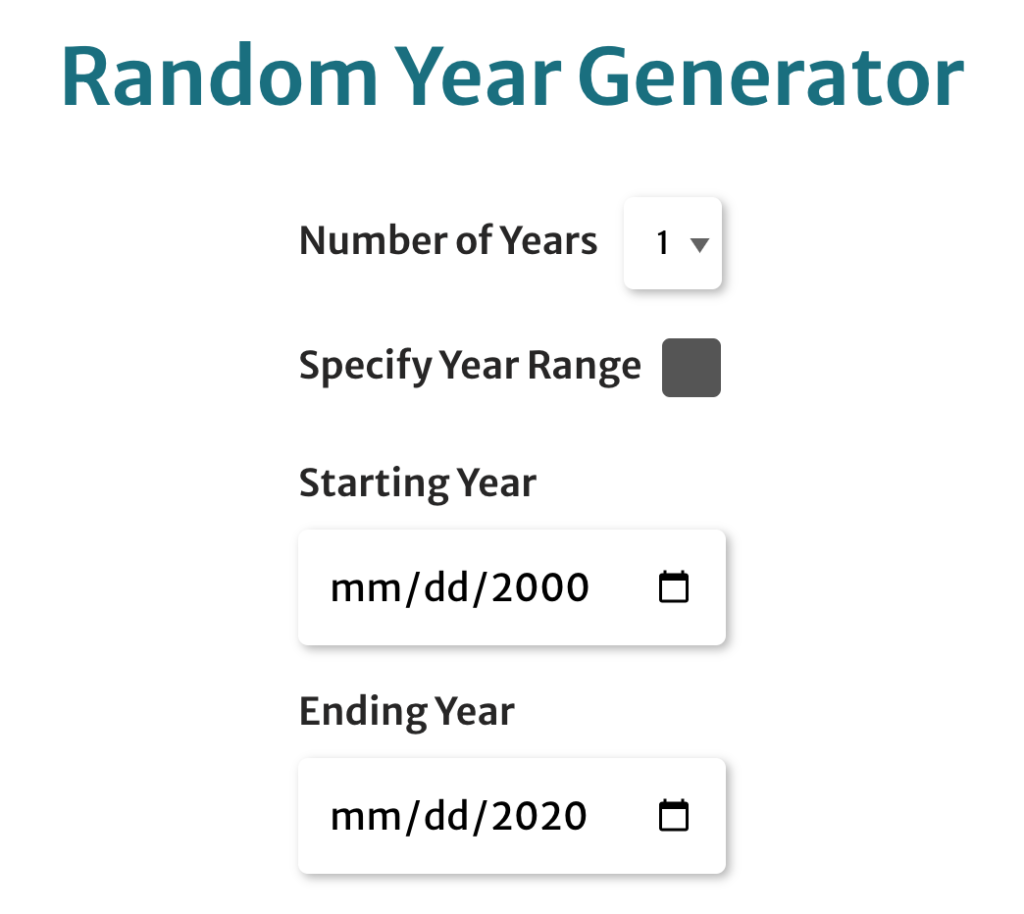
Yes. Select “Specify Year Range” and enter your starting and ending year. The generator will then only return years inside that window. For example, you can pick a year between 2000 and 2020, between 1950 and 1979, or any other range you set, including ranges spanning multiple millennia.
Does the generator include leap years?
Yes — every year is included, including leap years. However, the tool returns only the year number, not the date. If you also need a random date inside that year (including the correct number of February days), use the Random Date Generator linked at the bottom of this page.
Can I generate multiple random years at once?
Yes. The Random Year Generator can produce dozens of years per click. You set the count, click “Generate,” and the tool returns a list of independent random years. Specifically, this is useful for generating timelines, character birth years, or batch trivia questions in a single pass.
Are the generated years cryptographically secure?
No. The tool uses a standard browser pseudorandom number generator, which is more than sufficient for creative, educational, and casual use. However, it should not be used for cryptographic key generation, gambling, or any application where unpredictability is itself a security requirement.
What’s the earliest year the random year generator can return?
The earliest year is 1 AD. The tool does not currently support BCE/BC years or astronomical year numbering. Therefore, for ranges that include the prehistoric or ancient pre-Common-Era periods, a different tool is needed.
More Free Tools You Might Like
- Random Date Generator — generate a full random date inside any year, including the correct day of the week.
- Random Month Generator — pick a random month for prompts that need a season but not a specific date.
- Random Day of the Week Generator — pair with a random year for full date prompts.
- 12 Weeks From Today Calculator — useful when planning forward from a generated year.
- Number to Words Converter — convert any generated year (e.g., 1684) into written form for typesetting and writing prompts.