This demon name generator builds names from the same source material real demonologists used: the Ars Goetia, Hebrew apocrypha, Persian and Akkadian myth, and medieval Christian classifications of the Seven Princes of Hell. In other words, you get names that actually sound infernal because they follow the phonetic patterns of names like Asmodeus, Belphegor, and Naberius — not random consonant soup. Pick how many you want, choose male or female, and the demon name generator returns options with meanings you can drop straight into a novel, tabletop campaign, video game, or screenplay.
Demon Name Generator
Generate random demon names in seconds.
What This Demon Name Generator Does Differently
Most demon name tools shuffle harsh consonants together and call it a day. The result is something like “Krxazoth” or “Vrethag” — names that look spooky but have no roots, no rhythm, and no meaning. However, real demon names from the historical record almost always do three things at once: they encode a sin, vice, or domain; they end in a specific suffix tied to rank or origin; and they follow the cadence of the language they were borrowed from. Our demon name generator was built around those three rules, which is why the names it produces feel like they belong in the same room as Beelzebub and Asmodai rather than a 90s heavy-metal album cover.
Specifically, the tool draws from four naming wells. First, the 72 Goetic spirits of the Lemegeton (Lesser Key of Solomon), each with a known rank — King, Duke, Prince, Marquis, Earl, President, or Knight. Second, Hebrew-origin demons like Abaddon (“destruction”), Belial (“worthlessness”), Mammon (“greed”), and Leviathan (“sea monster”). Third, Persian and Akkadian roots — Aeshma (rage), Pazuzu (the wind demon of The Exorcist), and Asmodeus, whose name evolved from the Persian Aeshma-daeva. Finally, the Latin demonology that dominated medieval grimoires, where suffixes like -ius, -ax, and -mon mark a demon’s nobility.
As a result, every name the generator outputs has a believable etymology. You won’t get gibberish. Furthermore, you won’t get the same recycled list of public-domain names that show up on every other tool of its kind — there are over 50,000 unique combinations in the underlying word bank, and the meanings are tied to real linguistic roots rather than invented on the fly.
How the Demon Name Generator Builds Each Name
Under the hood, the generator follows a three-step process. Knowing how it works helps you understand why some names feel “right” the moment you see them and others don’t — and how to tell the generator to give you more of what you want.
Step 1 — Choose a phonetic root
The tool starts by pulling a root syllable from one of the four traditions. Hebrew roots tend to use guttural sounds — Bel-, Sam-, Az-, Ab-. Latin and Greek roots favor flowing vowels — Mal-, Astar-, Phen-. Persian roots often begin with a sharp consonant cluster — Aesh-, Pazu-, Daev-. Each root carries a meaning even before a suffix is added, which is why “Bel-” already feels heavier than “Mal-“.
Step 2 — Add a rank or domain suffix
Next, the tool appends one of roughly 40 suffixes. The most common are -ius (Latin nobility — Malphasius), -on (Hebrew/Greek — Abaddon, Apollyon), -eus (Greco-Roman — Asmodeus, Tartareus), -ax (Goetic harshness — Glasyalabolas, Stolax), and -mon or -moth (Hebrew demonic — Mammon, Astaroth). Notably, the suffix carries information about the demon’s role: -eus demons tend to be princely, while -ax demons are usually warriors or destroyers.
Step 3 — Tag the result with a meaning
Finally, the generator looks up the combined root + suffix in its meaning index and outputs a translation that reflects the actual roots. For instance, “Belmoth” returns “lord of corruption” because Bel- means “lord” in Akkadian/Hebrew and -moth shares an etymology with mortality and decay. Consequently, you can pick a generated name and immediately know what it signifies — useful when you’re matching the name to a character’s personality, sin, or sphere of influence.
The Naming Traditions Behind the Demon Name Generator
To use this demon name generator effectively for serious creative work — a published novel, a long-running campaign, a horror screenplay — it helps to know which tradition each name belongs to. Mixing traditions inside one work is fine, but matching a demon’s name to its lore tradition makes the worldbuilding feel deliberate.
Hebrew and apocryphal roots
The earliest named demons in Western tradition come from Jewish texts: the Hebrew Bible, the Book of Enoch, the Talmud, and the Zohar. These names almost always encode a moral concept — Belial means “worthless,” Mammon means “wealth/greed,” Lilith comes from a root meaning “night creature.” If your demon represents corruption, temptation, or a specific vice, lean Hebrew. The phonetics are guttural and the names tend to be short — two or three syllables.
Greco-Roman demonology
Greek and Latin demonology gave us the “noble” demons — those with titles, courts, and complex hierarchies. Apollyon (Greek for “destroyer”), Tartarus (the abyss beneath Hades), and the entire Latinized Goetic court fall here. These names are longer, more melodic, and often end in -eus, -ius, or -on. For your fantasy story’s archvillain or a demonic lord with a throne and a legion, Greco-Roman roots fit best.
Persian and Zoroastrian origins
Persian demonology — particularly Zoroastrianism — predates much of the Christian tradition and contributed several major names. Aeshma (rage) became Asmodeus. The daevas were a class of malevolent spirits whose name eventually became “devil.” Pazuzu, the wind demon, sits at the boundary between protector and threat. Persian roots feel ancient and elemental — useful when you want a demon that predates the modern moral framework.
Mesopotamian and Akkadian shadows
The oldest layer in the tool’s word bank comes from Mesopotamian sources — Sumerian, Akkadian, and Babylonian. Names like Lamashtu (the child-stealing demon goddess), Dagon (a fish-deity demoted to demon status), and Tiamat (chaos personified) live here. These roots are rare in most generators, but they’re the deepest well; if you want a demon whose name predates Christianity by 2,000 years, look for the harsher consonant clusters and shorter, declarative names.
The 72 Demons of the Ars Goetia: Ranks Used by the Demon Name Generator
The Ars Goetia, the first book of the 17th-century grimoire The Lesser Key of Solomon, is the single most important source for “noble” demon names in Western fiction. It catalogs 72 demons supposedly bound by King Solomon, each with a name, a rank, a sigil, and a list of powers. Importantly, the demon name generator uses the same rank system, so the names it produces can be slotted directly into a Goetia-style hierarchy if your story or game needs one.
Here are the seven Goetic ranks in descending order of power, each tied to a classical astrological body:
- Kings (Sun) — 9 in total. The most powerful Goetic demons. They appear crowned and command 60–85 legions. Examples: Bael, Paimon, Belial, Asmoday, Vine, Balam, Beleth, Purson, Zagan.
- Dukes (Venus) — 23 in total. The most numerous rank. Dukes ride monstrous mounts and teach hidden sciences. Examples: Agares, Vassago, Gusion, Eligos, Bathin, Sallos.
- Princes (Jupiter) — 12 in total. Princes reveal past and future and grant invisibility. Examples: Vassago, Sitri, Ipos, Stolas, Orobas, Seere.
- Marquises (Moon) — 12 in total. They appear in hybrid animal-human forms and teach skills. Examples: Amon, Naberius, Ronove, Forneus, Marchosias, Phenex.
- Earls / Counts (Mars) — 11 in total. Warriors and battle-tacticians. Examples: Botis, Morax, Furfur, Halphas, Räum, Bifrons.
- Presidents (Mercury) — 12 in total. Scholars and administrators. Examples: Marbas, Buer, Glasya-Labolas, Caim, Ose, Amy.
- Knights (Saturn) — 1 in total (Furcas). The lone knight is the rarest rank, often used in fiction for a wandering or exiled demon.
Some Goetic demons hold dual ranks (Vassago, for instance, is both a Prince and a Mighty One; Crocell is a Duke who was once a Power among the angels). Therefore, when you generate a name and want to assign a rank, you have flexibility: a Marquis-Duke combination is canonical and gives you a more complex character on the page.
The Seven Princes of Hell and the Sins They Embody
If the Goetia covers the demonic civil service, the Seven Princes of Hell cover the executive branch. The classification comes from a 1409 Lollard tract called The Lanterne of Light, later refined by 16th-century theologian Peter Binsfeld. Each prince rules over one of the seven deadly sins. Generally speaking, this is the framework most modern fantasy uses — from Dante’s Inferno to Helluva Boss to Dungeons & Dragons‘s Nine Hells.
- Lucifer — Pride. The fallen morning star, traditionally first among the princes.
- Mammon — Greed. From Aramaic for “wealth” — used as a personified evil in the Gospels.
- Asmodeus — Lust. Persian Aeshma-daeva, demon of wrath in origin, reassigned to lust by medieval Christianity.
- Leviathan — Envy. The biblical sea-monster, recast as the demon who circles in jealousy.
- Beelzebub — Gluttony. “Lord of the Flies” — Philistine god turned major demon.
- Satan — Wrath. The adversary; the prosecutor’s name from Hebrew.
- Belphegor — Sloth. Originally a Moabite god (Baal-Peor), now demon of laziness and sluggishness.
When you use the demon name generator and want a name that aligns with a specific sin, look at the phonetic patterns above. Pride and wrath demons tend to use sharp, declarative sounds (Luc-, Sat-). Greed and envy use sibilance (Mam-, Lev-). Sloth and gluttony are heavy and rounded (Bel-, Beel-). Asmodeus, the lust demon, is the outlier — its sound is melodic and fluid because it’s the youngest of the seven names, having traveled the farthest linguistically.
Male vs. Female Demon Names: Patterns That Actually Work
One of the most common questions writers ask: are demon names gendered? Historically, the answer is mostly no — demonology has been a male-dominated field, so the canonical lists skew overwhelmingly toward male names. However, female demons absolutely exist in the source material, and the demon name generator distinguishes them in two ways: by suffix and by lineage.
Female demon name patterns
Female demonic names generally end in -a, -ith, -is, or -ina. Lilith is the archetype — her name comes from the Hebrew layil (night) and her suffix -ith is unambiguously feminine. Other canonical female demons include Naamah (mother of divination), Agrat bat Mahlat, Eisheth Zenunim, and Lamia (Greek child-eating demoness whose name became the root word for vampire-like spirits). Additionally, the female-coded succubi class — Lilim, Lilin — also derives from Lilith. Specifically, when set to female, the generator favors these suffix patterns and pulls from the smaller but well-documented female roster.
Male demon name patterns
Male demonic names dominate the Goetia and end overwhelmingly in -us, -on, -or, -eus, or -ax. This isn’t an accident — Latin grammar gendered most demonic spirits male, and the Greek and Hebrew sources that fed into the medieval grimoires followed similar conventions. Therefore, if you want an instantly-recognizable male demon name, the suffix is doing most of the work. Try Belphegor (-or), Asmodeus (-eus), Mammon (-on), Glasyalabolas (-as), or Marbas (-as).
Non-binary and modern usage
Modern fiction has loosened these conventions considerably. In particular, fantasy novels and games like Hazbin Hotel, Critical Role, and Baldur’s Gate 3 use demon names that ignore historical gendering entirely. The demon name generator includes a “neutral” mode that pulls from suffixes used across both traditions (-ax, -oth, -eth, -ar) — perfect for non-binary characters or for cultures in your worldbuilding where demons aren’t gendered the way humans are.

How to Pick the Perfect Demon Name from the Generator
Generating a list is the easy part. Picking the name out of 50 candidates is where most writers stall. Here’s a practical filter that works for novels, campaigns, scripts, and game design alike.
- Read each name out loud. Demons get spoken — by characters, by narrators, by players around a table. If the name trips your tongue, your reader’s tongue will trip too. Cross out anything you can’t say cleanly on the first try.
- Match the sound to the role. A trickster demon should have a slippery, sibilant name (Sallos, Sitri, Stolas). A warlord demon needs hard consonants (Marax, Furfur, Halphas). A seducer needs flow (Asmodeus, Agares, Andras). The phonetics carry meaning before the meaning does.
- Avoid the “famous five” unless you’re being deliberate. Lucifer, Satan, Beelzebub, Belial, and Asmodeus are so well-known that using them at full strength can feel like fan fiction. If you want one of these in your story, consider using a partial form, an old name (Aeshma instead of Asmodeus), or a folkloric variant.
- Check the meaning before committing. The tool returns meanings for a reason — you don’t want to name your demon of cunning “destruction” by accident. A 30-second cross-check against the Goetia or a demonology reference saves rewrites later.
- Save 3–5 backups. Especially for D&D campaigns and TTRPGs, the demon you name will inevitably need siblings, lieutenants, or rivals. Pick your top name and bank four others from the same generator session — same tradition, same suffix family — so the cast feels like it belongs together.
Where to Use the Demon Name Generator (Beyond Just Stories)
Most users come to a demon name generator for fiction, but the practical applications go further. Specifically, here’s where this tool gets used most often, based on the queries that bring people to this page.
- Tabletop campaigns. Dungeon Masters running 5e, Pathfinder, or Call of Cthulhu need named demons by the dozen. The Goetia rank system maps cleanly onto D&D 5e’s demon CRs, and a session of generating + filtering produces a full demonic court in 20 minutes.
- Video games and indie dev. Roguelikes, RPGs, and horror games all benefit from a deep enemy roster with names that don’t repeat. Generated names tagged with rank and meaning make spawning and naming randomized boss encounters trivial.
- Heavy metal and dark synth bands. Demonic naming has been a metal genre convention since Black Sabbath. The demon name generator is regularly used by bands and producers naming albums, tracks, or stage personas.
- Tabletop wargaming. Warhammer 40K Chaos players, Age of Sigmar Slaves to Darkness, and Conquest demonic factions all need named heroes. Generated names slot in alongside Khorne and Slaanesh canon without breaking the aesthetic.
- Halloween, costume parties, and roleplay. A lighter use case, but a real one — the generator gets traffic spikes every October as people pick demon personas for parties, escape rooms, and live-action roleplay.
- Author worldbuilding. Dark fantasy and grimdark novelists use the generator to build their pantheons. Names can be regenerated until a coherent set emerges, then customized to fit the book’s invented language.
Famous Demon Names and What They Actually Mean
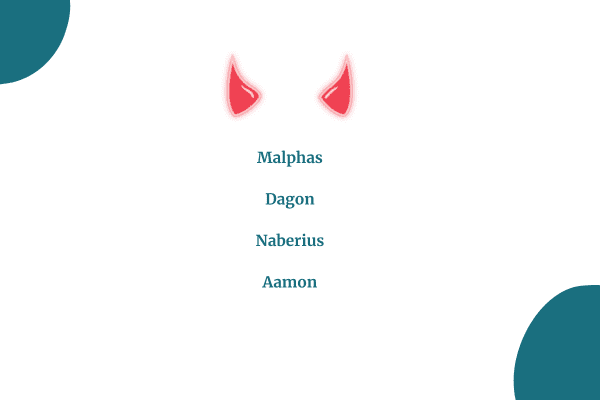
Before you publish a name, it’s worth knowing the meanings of the most-cited demons in pop culture — partly so you can use them well, partly so you don’t accidentally re-use one. Here are the etymologies of the names you’ll see most often:
- Abaddon (Hebrew, “destruction”) — the angel of the abyss in Revelation; later a demon king.
- Asmodeus (Persian Aeshma + daeva, “demon of wrath”) — Goetic king, prince of lust.
- Beelzebub (Hebrew Ba’al-Zebub, “lord of the flies”) — Philistine deity, prince of gluttony.
- Belial (Hebrew, “without value”) — Goetic king of 80 legions.
- Belphegor (Moabite Baal-Peor, “lord of opening”) — prince of sloth.
- Dagon (Akkadian, “grain” or “fish”) — Mesopotamian deity, demoted to demon.
- Leviathan (Hebrew, “twisted/coiled”) — biblical sea monster, prince of envy.
- Lilith (Hebrew, “night creature”) — first wife of Adam in apocrypha; mother of demons.
- Mammon (Aramaic, “wealth”) — personified greed.
- Naberius (uncertain, possibly Cerberus-derived) — Goetic marquis of eloquence.
- Pazuzu (Akkadian) — wind demon and protector against Lamashtu.
Demon Name Generator FAQ
Can I use names from the demon name generator commercially?
Yes. The names produced by this demon name generator are free to use in published books, indie games, films, podcasts, music, and any other commercial work. No attribution required. Generated names are not trademarked or copyrighted; the underlying historical names (Asmodeus, Beelzebub, etc.) have been in the public domain for centuries.
Are these real demon names or made-up ones?
Both. The generator pulls from a word bank that includes the 72 historical Goetic demons, the Seven Princes of Hell, and dozens of named demons from Hebrew, Persian, and Mesopotamian sources. Additionally, it produces lore-faithful new names by recombining authentic roots and suffixes. Specifically, that means a “made up” name from this tool will still feel etymologically correct — it follows the same construction rules a 17th-century demonologist would have used.
What’s the difference between a demon, a devil, and a daemon?
In modern usage, “demon” is a malevolent supernatural being, “devil” is often reserved for the singular figure of Satan or the high princes, and “daemon” (from Greek daimon) was originally morally neutral — referring to any spirit, good or evil. However, the lines blurred during the Christianization of the ancient world, when Greek daimones were reclassified as demons. For most fiction purposes, the words are interchangeable.
Are there demon names that are considered dangerous to write or speak?
This is purely a folklore question, not a real-world warning. Some occult traditions hold that speaking certain names — particularly the 72 Goetic demons by their full name and seal — can summon them. Most demonologists, even practicing ones, dismiss this for casual use; the traditional grimoires required ritual circles, specific timing, and a host of other conditions. For fiction and game design, you can safely use any name. Indeed, the entire metal music genre and most fantasy literature relies on this assumption.
How is this demon name generator different from others online?
Three things. First, it’s rooted in real demonological sources rather than randomized syllable shuffling, so names have actual etymologies. Second, every generated name is tagged with a meaning, which most competitor tools don’t do. Third, the underlying word bank is over 50,000 unique combinations, organized by tradition (Hebrew, Greco-Roman, Persian, Akkadian) and rank — so you can match the name to the role you need.
Can I use the demon name generator for D&D 5e or Pathfinder?
Absolutely — and the Goetia rank system maps cleanly onto D&D 5e’s demon and devil hierarchies. A Goetic King roughly corresponds to a 5e Demon Lord or Archdevil; Dukes and Princes work as named CR 15+ encounters; Marquises and Earls fit CR 10–15; Presidents and Knights work for lower-level named encounters. In 2026, several published 5e supplements explicitly reference the Goetia, so using these names won’t feel out of place at the table.
Related Generators on CalculatorWise
If you’re building a demonic cast, you’ll likely need names for the surrounding world too. The following generators on CalculatorWise pair naturally with the demon name generator for fantasy and tabletop projects:
- Dragonborn Name Generator — for the dragon-blooded warriors who hunt your demons.
- Elden Ring Name Generator — dark-fantasy names with the same gravitas as Goetic demons.
- Dwarf Name Generator — for the mortal heroes who oppose your demonic court.
- Giant Name Generator — for the primordial entities older than the demons themselves.
- Devil Fruit Generator — for cursed-power systems with demonic flavor.
Updated May 2026 — expanded with the full Goetia rank breakdown, Persian and Akkadian root analysis, and 2026 D&D 5e mapping.
More Free Tools and Content You Might Love
We have a number of other fantasy name generators on this site, such as:
- The Hogwarts Legacy Name Generator for magical character names by house and gender 🪄
- The Random Pokemon Generator for getting any Pokemon and their stats in seconds!
- Dwarf Name Generator, perfect for any Dwarf character 🧙🏼
- The Dwarven City Name Generator, which helps you get realistic Dwarven city names ⛰️
- Hobbit Name Generator, which is excellent if you need authentic Hobbit names fast 🧝♂️
- The Mentor Name Generator, which is perfect for a mentor character 🔮
- The Dragonborn Name Generator if you need D&D-inspired names 🐉
- The Devil May Cry Name Generator if you’re a fan of the famous Devil May Cry series 🎮
- Finally, the Demon Name Generator is amazing for demon names 😈
- The Giant Name Generator is fantastic for getting names for any type of giant 🗿