Looking for the perfect name for your new homestead, hobby farm, or fictional barnyard? The Farm Name Generator on this page spins up rustic, cute, funny, and family-style farm names in seconds, pulling from over 2,000 vetted name components arranged into themed categories. Whether you are registering an LLC in 2026, naming a Stardew Valley save, or branding a weekly CSA box, the generator delivers usable picks instead of recycled clichés. Below the tool, you will also find 120 hand-curated names across four styles, plus a working framework for choosing the one that actually fits your land.
Farm Name Generator
Generate amazing farm names in seconds.
How the Farm Name Generator Works
The Farm Name Generator runs on three inputs: style category, output count, and an optional prefix or suffix. First, pick a style — Best, Rustic, Cute, Funny, Family, or All (Random) — and the tool pulls from a separate word bank for each. Notably, every bank is structured around two slots: a descriptive lead (Cedar, Whispering, Iron Gate) and a land-type tail (Acres, Ranch, Homestead, Pastures, Orchard). The combinations are weighted so you never end up with awkward pairings like “Iron Gate Bunny” or “Buttercup Barn.”
Next, choose how many names you want — anywhere from one to ten per click. In practice, most users run the generator three or four times to surface 30 to 40 options before shortlisting. If none of the raw output feels right, open the Advanced panel and add a prefix like “The,” “Old,” or your family surname, plus a suffix like “Homestead,” “Orchard,” or “Acres.” The generator then injects your custom token into every result, which is how a generic suggestion like “Cedar Grove” becomes something personal like “The Hartman Cedar Grove Homestead.”
One important caveat: the names this tool produces are starting points, not finished legal picks. Specifically, you will still need to check your state’s farm registration database, the USPTO trademark search, and at least one domain registrar before committing to a name. We cover that workflow further down the page so you do not get blindsided three months in.

The Five Naming Styles, Decoded
The five style categories inside the Farm Name Generator are not just cosmetic labels. Each one is built from a different word bank that targets a different real-world use case. Importantly, choosing the wrong style is the single most common reason people end up with names that sound off — a wholesale dairy with a “Bunny Hill” name, for instance, will struggle on contracts and shelf labels.
Best is the safe-default category. It pulls from neutral, marketable terms (Heritage, Summit, Vista, Oakridge) that work equally well on a farmers market sign, a wholesale invoice, and a website footer. If you are running anything that touches retail, lead with this style.
Rustic emphasizes terrain and texture words — Cedar, Briarwood, Stonybrook, Maple Ridge. Specifically, this style fits established working farms, vineyards, ranches, and any operation that wants a “we have been here a while” feel. Notably, rustic names also age well; a name like “Stonybrook Pastures” reads the same in 2026 as it would in 1976.
Cute leans into whimsy: Bunny Hill, Buttercup Meadow, Snugglewood. This category is purpose-built for hobby farms, petting zoos, kids’ birthday venues, agritourism, and farm-themed children’s books. However, cute names rarely scale well — if you ever plan to wholesale, you will want a more neutral DBA underneath.
Funny goes hard on puns: Cluck Norris Ranch, Eggcellent Acres, Moo La La Land. Funny names earn their keep at farmers markets, on social media, and on roadside-stand signs because they generate word-of-mouth. On the other hand, they can also look unprofessional on B2B paperwork, so most pun-heavy farms register a sober legal name and use the funny one as a brand.
Family ties a surname to a land word: Anderson Family Homestead, O’Connor Orchard, Davidson Dairy. Especially for multigenerational farms, this style signals continuity and trust — two factors that matter when consumers are choosing between you and a faceless industrial supplier.
All (Random) shuffles every category together. Use it when you want maximum variety in a single batch, or when you have not decided what tone fits your operation yet.
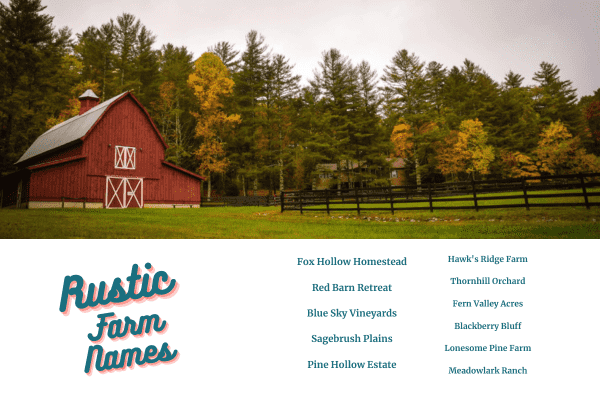
30 Rustic Farm Names from the Generator
- Cedar Grove Acres
- Whispering Pines Ranch
- Old Mill Farmstead
- Harvest Moon Homestead
- Rolling Hills Orchard
- Eagle’s Nest Farm
- Sunflower Fields
- Oakwood Meadows
- Iron Gate Farms
- Stonybrook Pastures
- Maple Ridge Estate
- Prairie Wind Homestead
- Riverbend Acres
- Wildflower Valley
- Willow Creek Ranch
- Autumn Harvest Farm
- Briarwood Pastures
- Golden Acres Ranch
- Silver Lake Farm
- Fox Hollow Homestead
- Red Barn Retreat
- Blue Sky Vineyards
- Sagebrush Plains
- Pine Hollow Estate
- Hawk’s Ridge Farm
- Thornhill Orchard
- Fern Valley Acres
- Blackberry Bluff
- Lonesome Pine Farm
- Meadowlark Ranch
Rustic names work because they pair a sensory descriptor (Whispering, Stonybrook, Briarwood) with a clear land word. Notably, the strongest picks above use double consonants or compound words — both of which slow the eye down and make the name stick. For example, “Stonybrook Pastures” lands harder than the technically-equivalent “Rocky Creek Fields” because the consonant cluster forces a slight pause before the second word.
30 Cute Farm Names That Charm Every Visitor

- Bunny Hill Farms
- Peachy Keen Orchards
- Snugglewood Farm
- Buttercup Meadow
- Cuddle Creek Farmstead
- Sweet Pea Acres
- Dandelion Den
- Honeybee Haven
- Puddle Duck Farm
- Fluffy Sheep Fields
- Little Fox Vineyards
- Giggleswick Ranch
- Bumblebee Orchard
- Daisy Chain Farm
- Happy Trails Homestead
- Jolly Green Farm
- Lullaby Lane Farms
- Tickled Pink Pastures
- Whisker Woods
- Polka Dot Meadow
- Ticklebelly Hill
- Cupcake Grove
- Poppet’s Plot
- Cherry Cheeks Farm
- Pipsqueak Plantation
- Sunshine Sprout Farm
- Bluebell Bluff
- Cotton Tail Acres
- Nibble Nook Farm
- Whimsy Woodland
Cute names sell exceptionally well in three contexts: agritourism (pumpkin patches, U-pick orchards, petting zoos), farm stay rentals on Airbnb, and any operation that markets primarily to families with young kids. However, before you commit, run the name past one test: would you feel comfortable putting it on a $25,000 wholesale invoice? If the answer is no — and for most cute names, it is — register a more neutral legal name like “Hill Country Holdings LLC” and use the cute name as a DBA brand.
30 Funny Farm Names That Make People Laugh

- Cluck Norris Ranch
- Moo La La Land
- Eggcellent Acres
- Baa Baa Lounge
- Quack Up Farm
- Hootenanny Homestead
- The Laughing Llama
- Gobble Gobble Grange
- Hee Haw Haystacks
- Squeal of Fortune Farm
- The Chuckling Chicken
- Moo-vin’ On Up Meadows
- Ducky McQuackface Farm
- Oinktopia Orchard
- Neigh Sayers Ranch
- Harey Situation Farm
- Baarney’s Place
- The Silly Goose Paddock
- Chicken Scratch Acres
- The Giggling Goat
- Ewe Crazy Farm
- The Quirky Quail
- Honk If You’re Hungry Farm
- The Jolly Jumper Ranch
- Woolly Mammoth Meadows
- The Punny Pig Pen
- Hoppin’ Happy Homestead
- The Rowdy Rooster
- Donkey Delight
- The Amoosed Moose Farm
Funny names live and die on one factor: the pun has to land in under one second. Specifically, if a customer has to think about why “Cluck Norris Ranch” is funny, the name is failing. The strongest puns above use a single phonetic swap (Cluck/Chuck, Moo/La, Baa/Bar, Eggcellent/Excellent) where the joke is instant. In contrast, the weakest funny names try to stack two jokes — those almost always feel forced and should be rerolled.
30 Family Farm Names That Honor Heritage

- Anderson Family Homestead
- Johnson’s Jolly Acres
- Murphy Meadows
- O’Connor Orchard
- Davidson Dairy
- Bennett’s Brook Farm
- Green’s Grove
- Miller’s Mountain Farm
- Carter Country
- Wilson’s Whispering Woods
- Taylor’s Tranquil Trails
- Clark’s Country Corner
- Lewis’ Lush Lands
- Harris Heritage Farm
- Walker’s Wilderness
- King’s Kin Farm
- Edwards’ Eden
- Robinson’s Retreat
- Thompson’s Thicket
- Moore’s Meadow
- Young’s Yield
- Harrison’s Harvest
- Brooks’ Brook
- Russell’s Rustic Range
- Morgan’s Meadow
- Bailey’s Bounty
- Fisher’s Farm
- Marshall’s Magic
- Gibson’s Grove
- Foster’s Field
Family-style names carry weight that the other categories cannot replicate. Specifically, when a customer sees “Davidson Dairy” or “O’Connor Orchard,” they assume there is a real family standing behind the product — and that assumption translates directly into trust. However, the format also locks you in. If the family name is hard to spell or pronounce (Czaplinski, Nguyenduong), it is usually better to lead with a place-based name and credit the family in your “About” page instead.
For multigenerational farms, a quiet best practice is to add the founding year on signage and packaging — “Davidson Dairy, Est. 1948.” That single addition signals continuity in a way that any modern startup farm cannot fake.
How to Pick the Right Name from the Farm Name Generator
Generating 40 candidates is the easy part. Picking the one you will actually use, register, and put on signage is harder — and most people skip steps that come back to bite them later. Below is a six-step shortlist process that mirrors what real farm-business advisors recommend in 2026.
Step 1: Cut Your List to Five Names
From your generator output, eliminate any name that fails the “say it on the phone” test. Specifically, if you would have to spell a name letter-by-letter to a wholesale buyer, drop it. This usually cuts a 40-name list down to 8–12 quickly. From there, pick the five that feel right when you read them out loud.
Step 2: Run the Domain and Social Handle Check
For each of your five names, check three things: the .com domain, the Instagram handle, and the matching Facebook page name. Furthermore, in 2026, TikTok and YouTube handles matter more than they did when most farm-naming guides were written, so add those too. Notably, you do not need every single platform to match exactly — but if all five are taken, that name is going to cause friction forever.
Step 3: Check State Farm Registries and the USPTO
Search your state’s Department of Agriculture business registry for any farm currently using that name within 100 miles of you. Additionally, run the name through the USPTO trademark database (uspto.gov/trademarks). A federally-registered trademark in your category — even from a farm two states over — is a hard stop, because they can demand you stop using the name once you reach any meaningful scale.
Step 4: Test the Name with Three Different Audiences
Send your top two names to three groups: family members who know your story, current or potential customers, and at least one person in your supply chain (extension agent, co-op manager, wholesale buyer). Importantly, weight the customer feedback most heavily — they are the ones writing the checks. If a name confuses customers but family loves it, that is a warning sign.
Step 5: Visualize the Name on Signage and Packaging
Mock the name up at three sizes: a roadside sign (4 feet wide), a market chalkboard (2 feet wide), and a product label (3 inches wide). Some names that look great in a 60-pixel logo become unreadable on packaging because of letter count. As a rule of thumb, two-word names with 12–18 total letters scale best across formats.
Step 6: Sleep on It, Then Decide
Pick your top name on a Friday and revisit it Monday morning. Notably, names you still love after a weekend are almost always the right choice. Names that nag at you on Sunday night usually have a flaw your gut already noticed — go back to your shortlist and pick the runner-up.
Naming Mistakes That Cost Real Farms Customers
Beyond the obvious legal traps, a handful of naming mistakes consistently hurt farm businesses. These are not theoretical — they are the issues that small-farm advisors and extension offices flag year after year.
Mistake 1: Naming the farm after a single product. “Heritage Heirloom Tomato Farm” sounds great until you want to sell eggs, lavender, or hay. As a result, established farms tend to use broader land-based names and let their products speak through the brand.
Mistake 2: Including a town name you might leave. “Brookfield Farms” is fine if you own land in Brookfield forever. However, if you ever expand or relocate, the name becomes a liability or forces an expensive rebrand. Generally, county and region names age better than town names.
Mistake 3: Picking a name that sounds like an existing brand. “Whole Acres Harvest” is too close to Whole Foods. Similarly, “King Soopers Ranch” or “Trader Joe’s Hill Farm” will draw legal attention. Always run your shortlist through a quick brand-similarity check.
Mistake 4: Including a year, season, or trend. “Farm 2026” or “Pandemic Pasture” lock you into a moment. In contrast, names with timeless words (Cedar, Heritage, Brook, Ridge) work the same way in 2026 as they will in 2046.
Mistake 5: Skipping the trademark search to “save time.” Trademark conflicts get more expensive the longer you wait. Specifically, fixing a conflict at year one might cost a few hundred dollars in domain and signage changes. By contrast, fixing it at year five — after you have built customer recognition — can cost five figures.
Frequently Asked Questions About the Farm Name Generator
Is this Farm Name Generator free to use?
Yes — the Farm Name Generator is free, requires no signup, and has no usage limit. You can generate as many batches of names as you want, and the names belong to you to use commercially. There is no watermark, no premium tier, and no email gate.
Can I use names from the generator for a real registered farm business?
Yes, but you still need to do the legal-availability checks before registering. Specifically, run the name through your state Department of Agriculture’s business search, the USPTO trademark database, and a domain registrar. The generator gives you starting points; the legal clearance work is on you.
What is the difference between rustic and family categories?
Rustic names emphasize landscape and texture (Cedar Grove Acres, Stonybrook Pastures), while family names anchor on a surname (Davidson Dairy, O’Connor Orchard). Generally, rustic names work better when you are starting fresh and want broad appeal. By contrast, family names work better when you have multigenerational land or want to signal personal accountability.
Will the Farm Name Generator suggest names that are already trademarked?
The generator builds names from a curated word bank, so most outputs are unique combinations. However, the tool does not check the USPTO database in real time. As a result, you should always run your final pick through trademarkia.com or uspto.gov before printing signs or registering an LLC.
How many names should I generate before picking one?
Most people benefit from generating 30–50 candidates across two or three categories. Specifically, run the Farm Name Generator with 10 names selected, click generate three times, then mix in a Family or Rustic batch for variety. From there, you can comfortably narrow down to a top five.
Can I use the generator for a fictional or video-game farm?
Absolutely. The Farm Name Generator works just as well for Stardew Valley saves, Animal Crossing islands, novel settings, tabletop RPG worldbuilding, and Roblox farms. For fictional uses, the Cute and Funny categories tend to fit best because in-game farms reward personality over neutrality.
Related Tools and More Naming Resources
If you need additional naming help for adjacent farm-life projects, these tools on CalculatorWise are the closest fits:
- Barn Name Generator — purpose-built for naming the buildings on your farm rather than the operation itself.
- Wolf Pack Name Generator — useful if your farm includes a working dog pack or you are naming a livestock-guardian operation.
- Mountain Name Generator — pair a generator-built farm name with a custom landmark name for ranches and large rural acreage.
- Newsletter Name Generator — many farms now publish a CSA or homestead newsletter; this tool builds matching publication names.
- School Name Generator — for farm-based education programs, agritourism field trips, or homeschool co-ops.
Each of these uses the same two-slot generation pattern as the Farm Name Generator, so the workflow you learned here transfers directly. Pick a category, set your count, optionally add a prefix or suffix, then run the same six-step shortlist process from above before committing.
Even More Free Tools and Content You Might Love
- The Song Association Game is a super fun online game to test your musical knowledge 🎶
- Try the amazing Random Pokemon Generator to get a random pokemon and stats 🐙
- The Ice Breaker Generator gives you awesome ice breaker questions for any situation 🧊🔨
- Random State Generator to get the best travel tips and foods for each state 🌎
- The Charades Generator to get great Charades words, a built-in timer, and a scorekeeper
- Finally, the Blank Slate Word Generator gives you words for the Blank Slate game. 🎲
- The Navi Name Generator gives you Avatar names in seconds 🎥
- Name Coloring Pages Generator for kids to print and color their names in a cool font 🖍️
- The Random NBA Team Generator to get random teams in a click of a button! 🏀
- Random MLB Team Generator to get a random MLB team right away ⚾
- As well as the Random NHL Team Generator to generate a random NHL team 🏒
- And of course, the Random NFL Team Generator for getting random NFL teams 🏈
- The Angel Number Calculator to figure out your Angel Number 😇
- Aunt Name Generator helps you get the perfect aunt’s name for your book, game, or story in seconds! 👩
- The Street Name Generator can help you come up with the right street name for your project, by letter! 🛣️
- Additionally, the Joke Generator has tons of funny family jokes and one-liners. 🤣
- Instagram Password Generator allows you to create highly-secure passwords in seconds for free. 🖥️