Need a hobbit name that actually sounds like Tolkien wrote it? Our hobbit name generator pulls from Tolkien’s canon — the Old English roots behind names like Frodo, the floral patterns behind Rosie and Primula, and the thirty-plus Shire family surnames documented across The Hobbit, The Lord of the Rings, and Tolkien’s own Guide to the Names in The Lord of the Rings. Pick a gender, set how many names you want, and get results with meanings every time.

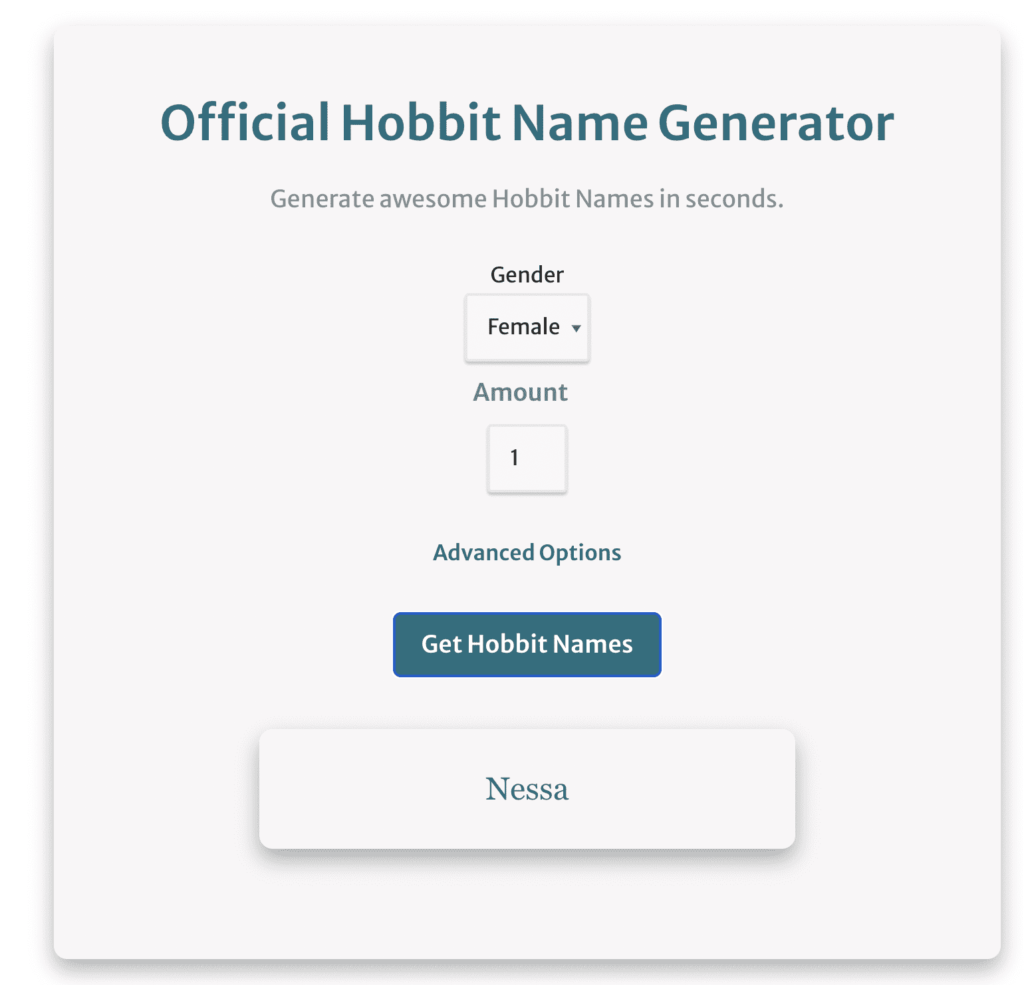
Official Hobbit Name Generator 🌿
Generate awesome Hobbit Names in seconds.
How the Hobbit Name Generator Works
The hobbit name generator runs on a curated list of canon and canon-adjacent names organized by Tolkien’s actual rules — not random fantasy syllables stitched together. Every output pairs a structurally correct first name with one of the documented Shire surnames.
To use the generator, follow these steps:
- Pick a gender. Choose male, female, or any. The generator pulls from gender-specific name pools because Tolkien followed distinct conventions for each.
- Set the count. Generate 1 to 10 names per click.
- Add a prefix or suffix (optional). For example, add “Mayor” as a prefix or “of Hobbiton” as a suffix to dress up the result.
- Click “Get Hobbit Names.” Each result pairs a first name with one of the documented Shire surnames.
- Click again until you find one you like. Every click produces a fresh combination.
Most hobbit name generators online produce nonsense — random English words mashed together with vaguely cute syllables. Furthermore, most ignore the actual structural rules Tolkien spent forty years building. Our hobbit name generator follows three concrete Tolkien-derived patterns: two-syllable masculine names ending in –o (Bilbo, Frodo, Drogo), feminine names drawn from flowers, gemstones, or Latinate forms ending in –a (Belladonna, Marigold, Pearl), and surnames pulled from the documented Shire family lines. Specifically, every result you get is structurally consistent with names Tolkien himself wrote.
The Three Layers of Hobbit Naming Conventions
Hobbit names look simple at first glance — Bilbo Baggins, Sam Gamgee, Rosie Cotton — but Tolkien actually layered three distinct elements into the system. Understanding them helps you spot a fake “hobbit name” the moment you see one.
Layer 1: The Personal Name (First Name)
The first layer is the personal name, given at birth. Notably, Tolkien split these by gender along strict aesthetic lines. Masculine names are short — almost always two syllables — and end in –o or, less commonly, a hard consonant cluster. Feminine names are longer, softer, and lean heavily on flora, gemstones, and Latinate suffixes ending in –a. Importantly, the rare exceptions to this pattern — Hamfast, Paladin, Saradoc — almost always come from the older Fallohide branch of the hobbit family tree.
Layer 2: The Family Surname
The second layer is the family surname, and this is where most generic hobbit name tools fail. Tolkien did not invent surnames at random. Instead, every Shire family name falls into one of three documented categories: ancient untranslated names with no clear meaning (Took, Baggins, Bolger, Boffin, Bunce), descriptive names tied to a physical trait or behavior (Proudfoot, Goodchild, Sandyman, Hornblower), or geographic names tied to a Shire location (Brandybuck from the Brandywine, Underhill from living under a hill, Brockhouse from a badger sett).
Layer 3: The Descriptor (Optional)
The third layer is the descriptor — the “of Buckland” or “the Old” tag that appears occasionally in the appendices. Most hobbits do not use this, but heads of family, mayors, and renowned figures often pick one up. For example, Tobold Hornblower is sometimes referenced as “Tobold the Old” in pipeweed lore. Similarly, the heads of the Took family pick up the title “Thain” rather than a personal descriptor. This layer is optional in the hobbit name generator (use the prefix and suffix fields) but useful for distinguishing one Bolger from another in a story with several.
Male Hobbit Names: Two Syllables, Always Ending in ‘-o’
The two-syllable, –o-ending pattern is the single most reliable rule for spotting a real hobbit male name. Bilbo, Drogo, Frodo, Otho, Bingo, Bungo, Fosco, Falco, Folco, Largo, Longo, Lotho, Minto, Polo, Ponto, Posco, Sancho — every one of these is structurally identical. Notably, this pattern was so consistent that Tolkien used –o himself as an in-universe joke: in the appendices to The Lord of the Rings, he notes that hobbits considered –o “a proper masculine ending.”
The Old English etymology behind these names goes deeper than the pattern alone. For instance, Frodo derives from the Old English fród, meaning “wise from experience” — a deliberate choice for a character who matures through trauma. Similarly, Samwise comes from Old English samwís, “half-wise,” a self-deprecating name fitting for a humble gardener. In contrast, Bilbo appears to have been entirely invented by Tolkien with no clear etymology, though some scholars connect it to Bilbao steel.
A few canon male names break the –o pattern, and these are worth knowing if you want variety. Hamfast (Sam’s father), Halfast, Paladin (Pippin’s father), Saradoc (Merry’s father), Wilcome, Holfast, Hildibrand, Adelard, and Reginard all come from older or more aristocratic hobbit lines. Generally, the –o ending dominates the Shire’s middle classes; the exceptions cluster around the Took and Brandybuck families, which are descended from the Fallohide branch.
30 Male Names from the Hobbit Name Generator
Here is a sample of 30 male names the hobbit name generator can produce, with their structural origin:
- Bilbo — Tolkien-invented; possibly linked to Bilbao steel
- Drogo — Old Germanic, “to carry” or “to bear”
- Frodo — Old English fród, “wise from experience”
- Otho — Germanic, “wealth” or “fortune”
- Bingo — Tolkien’s original draft name for Frodo
- Bungo — Bilbo’s father; possibly from a Germanic root for “round”
- Fosco — Italian, “dark”; Drogo’s brother in canon
- Falco — Latin, “falcon”
- Folco — Boffin variant; Frodo’s friend in canon
- Largo — Italian musical term, “broad” or “slow”
- Longo — “Long” with the masculine –o ending
- Lotho — Old English hloth, “loot” or “spoil”
- Minto — variant of “mint”; Boffin family
- Polo — Latin, “head”; Baggins family
- Ponto — Latin, “bridge” or “sea”
- Posco — Old Germanic; Baggins family
- Sancho — Spanish, “saint”; Proudfoot family
- Andro — short for Andwise, Sam’s uncle
- Cosimo — Tolkien-invented; Sancho Proudfoot’s son
- Dudo — Old English, possibly “the people”; Baggins line
- Griffo — Boffin family; possibly from “griffon”
- Hildigrim — Old English, “battle-fierce” (Took family)
- Holman — Old English, “hollow man”; Greenhand family
- Marmadoc — Welsh-Germanic blend; Brandybuck family
- Meriadoc — Welsh, “of the sea-fort”; Pippin’s cousin Merry
- Odo — Old Germanic, “wealth”; Proudfoot family
- Olo — Old Norse, “ancestor”; Proudfoot family
- Paladin — Latin, “court official”; Pippin’s father
- Peregrin — Latin, “traveler” or “pilgrim”; Pippin’s full name
- Saradoc — Welsh-Germanic; Brandybuck family
Female Hobbit Names: Flowers, Gemstones, and the ‘-a’ Ending
Female hobbit names follow three nested patterns, and the hobbit name generator uses all three. The first and most visible pattern is the flower or plant name: Primrose, Marigold, Daisy, Rosie, Lily, Myrtle, Heather, Pansy, Tulip. Tolkien drew this directly from rural English naming traditions of the 19th century, where giving daughters flower names was common in working-class families. In Shire terms, this pattern dominates the middle and lower classes — particularly the Cotton, Gamgee, and Goodchild lines.
The second pattern is the gemstone name, used almost exclusively by the Took family. Pearl, Pimpernel, Pervinca, and Diamond are all daughters or descendants of Thain Paladin Took. Importantly, this signals social rank: gemstone names belong to the Shire’s “old wealth,” and you would not typically see a Cotton daughter named Diamond. Pimpernel and Pervinca are unusual choices — both are flower names with a precious-metal ring to them, fitting the Took preference for a slightly grander register.
The third pattern is the Latinate –a ending, used for older or more formal hobbit women. Belladonna (Bilbo’s mother), Adamanta (Pearl’s grandmother), Lalia (the “Great” Took matriarch), Donnamira, Mirabella, Primula (Frodo’s mother), and Esmeralda (Merry’s mother) all share this pattern. Specifically, these names borrow Italianate or Latinate forms — a deliberate choice to mark the Took, Brandybuck, and other Fallohide-descended families as more aristocratic.

35 Female Names from the Hobbit Name Generator
Each of the following is canon, near-canon, or built from the documented patterns the hobbit name generator follows:
- Adamanta — Latinate, “unbreakable”; Took family
- Amaranth — the everlasting amaranth flower; Brandybuck line
- Asphodel — flower; Frodo’s cousin
- Belladonna — Italian, “beautiful lady”; Bilbo’s mother
- Berylla — gemstone (beryl) plus –a ending; Boffin
- Camellia — flower; Sackville family
- Daisy — flower; Gamgee family
- Diamond — gemstone; Pippin’s wife in canon
- Donnamira — Latinate; Took matriarch
- Dora — Greek, “gift”; Baggins line
- Eglantine — sweetbriar flower; Pippin’s mother
- Elanor — fictional flower Tolkien invented; Sam’s daughter
- Esmeralda — Spanish, “emerald”; Brandybuck family
- Estella — Latin, “star”; Brandybuck
- Goldilocks — folk name; Sam and Rosie’s daughter
- Hilda — Germanic, “battle”; Bracegirdle family
- Lalia — Greek, “talk”; the “Great” Took matriarch
- Lily — flower; Cotton family
- Lobelia — flower; Sackville-Baggins (Bilbo’s antagonist cousin)
- Marigold — flower; Sam’s sister
- May — month plus flower association; Cotton
- Mentha — Latin, “mint”; Brandybuck line
- Mirabella — Latinate, “wonderfully beautiful”; Took
- Pansy — flower; Bolger family
- Pearl — gemstone; Took family
- Pervinca — periwinkle in Latin; Took family
- Pimpernel — flower; Took family
- Poppy — flower; Bolger family
- Primrose — flower; Sam’s daughter
- Primula — Latin form of primrose; Frodo’s mother
- Rosa — Latin, “rose”; Baggins family
- Rosamunda — Germanic, “horse-protection”; Took
- Rosie — flower; Cotton family (Sam’s wife)
- Ruby — gemstone; Gamgee family
- Salvia — Latin, “sage”; Bracegirdle family
Hobbit Family Surnames Explained: 30 Shire Houses
Hobbit family surnames are where the hobbit name generator gets specific. Importantly, every surname in the pool comes from one of three Tolkien-documented categories: untranslated old names, descriptive names, and geographic names.
The Old Untranslated Surnames (Pre-Shire)
These names predate the founding of the Shire and have no clear in-universe meaning. Tolkien noted in his Guide to the Names that these were the oldest surnames, belonging to the most established families. The list is short but important: Took, Baggins, Bolger, Boffin, Bunce, Goold, Hayward. Notably, every one of these families plays a major role in The Hobbit or The Lord of the Rings.
The Descriptive Surnames
Most Shire surnames fall in this category, describing a physical trait, an occupation, or a personality quirk. For example:
- Proudfoot — a family known for unusually large feet, even by hobbit standards
- Goodbody — well-fed and respected
- Goodchild — a well-behaved family line
- Hornblower — pipeweed growers and merchants of Longbottom
- Sandyman — millers in Hobbiton
- Fairbairn — “fair child”; descendants of Sam Gamgee through his daughter Elanor
- Twofoot — minor Hobbiton family
- Whitfoot — Mayor Will Whitfoot of Michel Delving’s family
- Headstrong — stubborn family from the Northfarthing
- Brockhouse — “badger house,” likely a hobbit hole resembling a sett
- Smallburrow — Shire-reeves and hobbit-police; a small dwelling
The Geographic Surnames
These names mark a family by where they lived. For instance:
- Brandybuck — from the Brandywine River and Buckland
- Underhill — lived under a hill (Frodo’s pseudonym in Bree)
- Greenhand — gardeners from Hobbiton
- Tunnelly — lived in tunnels rather than holes
- North-took and South-took — geographic branches of the Took family
- Roper — likely a working surname for rope-makers in Tighfield
The Working Surnames
A subset of descriptive names tied directly to a profession. For example:
- Gamgee — short for Gamwich; the Gamgees were originally from the village of Gamwich in the Westfarthing before settling in Hobbiton
- Cotton — from “cot-town,” meaning “cottage village”; a farming family
- Burrows — diggers and hole-makers
- Sackville — wealthy upper-middle-class line, allied with Bagginses by marriage
- Bracegirdle — “tight belt,” a humorous comment on hobbit waistlines
The 2025 video game Tales of the Shire (developed by Wētā Workshop) uses many of these documented surnames in its character creator, including Took, Brandybuck, Proudfoot, Cotton, Burrows, Hornblower, Goodchild, Boffin, Chubb, and Bolger. Specifically, the hobbit name generator pulls from this same canonical pool, so any name you generate would feel at home in the game’s Bywater village.
Best Hobbit Name Generator Names by Use Case (2026)
Different projects need different names. Naturally, a tabletop RPG halfling needs a different feel from a Tales of the Shire avatar. Here is how to use the hobbit name generator for the most common use cases this year.
For D&D and Pathfinder Halfling Characters
D&D halflings borrow heavily from hobbit aesthetics, but they tend to skew slightly more adventurous. For example, lean toward male names with –o endings that suggest movement (Pippo, Bingo, Cosimo) and surnames with motion (Brandybuck, Underhill, Tunnelly). For female characters, gemstone names like Pearl, Diamond, and Ruby tend to read as more “adventurer” than the soft flower names.
For Tales of the Shire (2025) Character Creation
Wētā Workshop’s hobbit life-sim launched on July 29, 2025 and uses canon family names exclusively. Use the hobbit name generator to find combinations that match the game’s Bywater setting — names like “Daisy Cotton,” “Rosamunda Took,” or “Drogo Boffin” will fit seamlessly into the player community.
For Lord of the Rings Online (LOTRO)
LOTRO has been running since 2007 and has stricter naming rules than most MMOs. The two-name format the generator produces fits LOTRO’s first-name-plus-surname scheme. Particularly useful: avoiding the most overused names. Bilbo, Frodo, Sam, and Rosie are usually taken on every server.
For Fanfiction and Original Stories
For fanfiction set in the Shire, you usually want names that feel canon-adjacent without copying named characters. The hobbit name generator deliberately keeps the most famous canon names (Frodo, Sam, Bilbo) out of the standard rotation, so most outputs are fresh.
For Pets, Plants, and Houseplants
A surprising use case: the hobbit name generator works beautifully for naming pets, especially cats (Pippin, Pickle, Pearl) and ornamental plants (Lobelia, Belladonna, Marigold). Generally, the –o male names work especially well for small dogs, while flower names suit cats and rabbits.
For Story Pen Names and Newsletters
For writers wanting a cozy, Shire-inflected pen name, female flower names paired with old surnames (Primula Underhill, Rosie Boffin) create an instant aesthetic. Similarly, a male –o name plus a working surname (Cosimo Cotton, Drogo Burrows) works well for cottagecore newsletters.
How to Pick a Lore-Accurate Name from the Hobbit Name Generator
Generating a name is the easy part. Picking the right one takes a little intentionality. Use this five-step method to land on something that feels right for your project.
1. Decide Which Hobbit Branch You’re Channeling
There are three hobbit branches in Tolkien’s lore: Harfoots (the smallest, most rural, and most common — about 60% of Shire-folk), Stoors (broader, sometimes bearded, riverside-dwelling — Sméagol/Gollum was a Stoor), and Fallohides (the rarest, lighter-skinned, taller, and more aristocratic — Tooks and Brandybucks descend from this branch). Notably, the Rings of Power TV series featured the Harfoots prominently in seasons 1 and 2, which has driven a lot of new interest in the branch. For a Harfoot character, lean toward simple flower or –o names. For a Fallohide, the Latinate –a feminine names and Welsh-derived male names like Meriadoc and Saradoc read more aristocratic.
2. Match the Surname to the Personality
If your character is grounded and earthy, go with Cotton, Gamgee, or Goodchild. If they are old wealth, use Took, Baggins, or Boffin. If they are a wanderer or live on the edge of the Shire, lean toward Underhill, Tunnelly, or Brandybuck. Specifically, the surname is doing a lot of social-class signaling in Tolkien’s writing — match it to your character’s backstory.
3. Avoid Names That Break Canon
Specifically, avoid named major characters. Using “Frodo Baggins” or “Samwise Gamgee” reads as fan-fiction shorthand at best. Similarly, sidestep famous side characters like Lobelia or Otho. The hobbit name generator is designed to skip the most overused canon names, but a few classic flower names (Rosie, Lily, Daisy) sneak through because they were genuinely common.
4. Test the Rhythm
Read the name out loud. A real hobbit name has a balanced, almost iambic rhythm: BIL-bo BAG-gins, FRO-do UN-der-hill, ROS-ie COT-ton. If your name lands awkwardly with too many stressed syllables in a row, regenerate.
5. Check the Initial-Letter Patterns
Tolkien quietly used alliteration within hobbit families. The Tooks favor “P” names — Peregrin, Paladin, Pearl, Pimpernel, Pervinca, Pippin. The Bagginses favor “B” — Bilbo, Bungo, Bingo, Belladonna. For internal consistency in a multi-character story, lean into the same alliterative pattern.
Hobbit Name Generator FAQ
What is the most common hobbit family name?
Took, Brandybuck, Baggins, and Boffin are the four most prominent in canon, but in terms of sheer Shire population, Cotton, Burrows, and Bolger are the most common everyday surnames. Specifically, the “old four” appear most often in Tolkien’s narratives because they are the wealthier, more story-relevant lines.
Why do most male hobbit names end in “-o”?
Tolkien followed a real Old English and Old Germanic pattern where masculine names often ended in –a, which became –o in the hobbit naming “translation” he applied. For example, fród became Frodo, and drōga became Drogo. Importantly, this pattern is consistent across the male names in The Hobbit and The Lord of the Rings, with only a few exceptions in older Fallohide families.
Are hobbit names the same as halfling names in D&D?
They are very similar but not identical. D&D halflings borrow heavily from hobbit conventions for legal reasons — the Tolkien estate’s IP protection on “hobbit” pushed Wizards of the Coast to use “halfling” instead — but D&D halflings tend toward slightly more adventurous-sounding names. Generally, the hobbit name generator works for both, though purist D&D players sometimes prefer custom halfling lists.
Can I use names from this hobbit name generator commercially?
The names themselves — Bilbo, Frodo, Sam — are owned by the Tolkien estate when used in association with hobbits, the Shire, or other Middle-earth elements. However, the underlying names (Frodo, Otho, etc.) are public-domain Old English or invented words and can be used freely in non-Middle-earth settings. For commercial fantasy work, treat the hobbit name generator as inspiration rather than direct copy-paste, and make sure your final usage doesn’t infringe on Tolkien-trademarked elements.
What’s the difference between Harfoot, Stoor, and Fallohide names?
Harfoots are the most numerous and use the simplest flower-and-–o names. Stoors lean toward stronger, sometimes Welsh-sounding names — Sméagol himself was a Stoor. Fallohides use the most aristocratic patterns: Latinate feminine names ending in –a and Welsh masculine names like Meriadoc and Saradoc. The hobbit name generator pulls from all three, so generated results reflect the full Shire population.
Did Tolkien actually translate hobbit names?
Yes, in-universe. Tolkien insisted that what we read as “Frodo Baggins” was actually his English translation of the Westron name “Maura Labingi.” The –o ending preserves the masculine ending of the original Westron, and “Baggins” was Tolkien’s translation of “Labingi,” which referenced a small bag-shaped object. Furthermore, this fictional translation framework lets Tolkien justify why Shire names sound so much like rural English names rather than alien fantasy words.
Related Name Generators on CalculatorWise
If you’re building out a fantasy world and need names beyond the Shire, calculatorwise has more name generators that pair well with hobbit characters. The Dwarf Name Generator covers the Khazad-dûm side of Middle-earth, and the Half Elf Name Generator works for Rivendell and mixed-heritage characters. For non-Tolkien fantasy, the Elden Ring Name Generator and the Dragonborn Name Generator cover D&D-adjacent fantasy worlds. Finally, the Gnome Name Generator and the Hogwarts Legacy Name Generator are good companions if you’re building a multi-character party.
Updated April 2026 — refreshed with surnames from Tales of the Shire (2025) and notes on the Harfoot branch featured in The Rings of Power.
More Free Tools and Content You Might Love
We have a number of other fantasy name generators on this site, such as:
- The Hogwarts Legacy Name Generator for magical character names by house and gender 🪄
- The Random Pokemon Generator for getting any Pokemon and their stats in seconds!
- Dwarf Name Generator, perfect for any Dwarf character 🧙🏼
- The Dwarven City Name Generator, which helps you get realistic Dwarven city names ⛰️
- Hobbit Name Generator, which is excellent if you need authentic Hobbit names fast 🧝♂️
- The Mentor Name Generator, which is perfect for a mentor character 🔮
- The Dragonborn Name Generator if you need D&D-inspired names 🐉
- The Devil May Cry Name Generator if you’re a fan of the famous Devil May Cry series 🎮
- Finally, the Demon Name Generator is amazing for demon names 😈
- The Giant Name Generator is fantastic for getting names for any type of giant 🗿