Need a codename that actually feels like it belongs in the Metal Gear universe? This Metal Gear Name Generator builds names using the same patterns Hideo Kojima used across the series — the FOXHOUND animal-and-modifier formula, the Cobra Unit emotion suffixes, and the Diamond Dogs animal codename system. Pick boss or soldier, choose a gender, set the count, and you’ll get codenames that read like they belong on a tactical briefing rather than a random name list.
Official Metal Gear Name Generator 🎮
Generate awesome Metal Gear boss and character names in seconds.
How the Metal Gear Name Generator Works
Most online generators slap two random words together and call it a day. This Metal Gear Name Generator does something different. The output draws from three distinct naming traditions inside the franchise, so the codenames you see follow patterns Kojima actually used. Specifically, the tool blends curated word banks for animals, modifiers, abstract emotions, and military descriptors — and then filters them by the slot you choose (boss vs. soldier, male vs. female).
Furthermore, the generator separates “boss-tier” codenames from “soldier-tier” codenames the way the games do. Bosses inside FOXHOUND, the Cobra Unit, and the Beauty and the Beast Corps all carry two-part names with strong descriptive modifiers (Sniper Wolf, Vulcan Raven, Quiet, Skull Face). Rank-and-file Diamond Dogs operatives get tagged with simpler animal handles (Wild Dog, Yellow Hawk, Red Fox). Therefore, choosing “boss” tilts the output toward the cinematic, two-word format, while “soldier” pulls from the shorter operational style.
The Real Logic Behind Metal Gear Codenames
If you want to understand why some generated names feel right and others feel like clip-art, you need to understand the three core naming systems in the series. Each unit invented codenames for a specific reason, and once you see the pattern, you can use the Metal Gear Name Generator more deliberately — pick the result that fits the canon, or remix it to match your own faction.
The Animal + Modifier Pattern (FOXHOUND)
FOXHOUND is the gold standard. Every member’s codename pairs an animal with a personal identifier that hints at their combat specialty. Solid Snake (stealth), Liquid Snake (genetic counterpart), Sniper Wolf (long-range precision), Psycho Mantis (psychic warfare), Vulcan Raven (heavy weapons), Decoy Octopus (impersonation), and Revolver Ocelot (gunslinging interrogation). The “Snake” branch in particular uses physics terms — solid, liquid, solidus — because Kojima wanted names that felt opposite to “soft” while hinting at the boundary state between forms.
For your own use, this pattern works because the modifier does the heavy lifting. “Wolf” alone is generic. “Sniper Wolf” is a character. So when you see a result like Iron Lynx or Ghost Falcon come out of the Metal Gear Name Generator, ask yourself: does the modifier signal a job? If yes, keep it.
The “The [Emotion]” Pattern (Cobra Unit)
The Cobra Unit from Metal Gear Solid 3: Snake Eater uses a totally different system. Each member is named after a specific emotion experienced on the battlefield: The Boss, The Pain, The Fear, The End, The Fury, and The Sorrow. The codenames are intentionally abstract because the Cobras were veterans of WWII whose battlefield experiences had crystallized into pure feeling. The End feels oblivion. The Sorrow grieves the dead. The Fury burned alive in the upper atmosphere and brought that rage back as a weapon.
Notably, this pattern is the rarest in the franchise — and the most powerful when used right. If you generate a result and want to elevate it, try collapsing it into a single emotion: instead of “Bronze Reaper,” try “The Reaper.” Instead of “Hollow Wolf,” try “The Hollow.” Use this pattern sparingly. One Cobra-style name in your story carries weight; six of them feel like cosplay.
The “State + Snake” Pattern (Les Enfants Terribles)
This is the most exclusive pattern and the most loaded. The “Snake” lineage — Solid, Liquid, Solidus, Naked, Venom, Punished — was reserved for clones and inheritors of Big Boss. Solid and Liquid are obvious physics references. Solidus, however, is more interesting: it’s not a state of matter, it’s the boundary line between solid and liquid on a phase diagram. Kojima picked it specifically to signal that George Sears was something between his predecessors, neither and both.
For your own writing, “Snake + Adjective” should be earned. Use it for a protagonist with mythic weight, not a side character. Alternatively, swap “Snake” for another flagship animal in your faction (Wolf, Bear, Hawk) and keep the modifier rule intact: the adjective has to mean something.
How to Use the Metal Gear Name Generator Step by Step
The interface is intentionally minimal. Here is exactly how each control affects the output.

- Name Type. Select Boss for two-word, modifier-heavy codenames in the FOXHOUND or Beauty and the Beast Corps style. Select Character (soldier) for tighter, single-modifier handles closer to MSF and Diamond Dogs grunt callsigns. The pool of words behind each option is different — boss results lean toward dramatic adjectives (“Phantom,” “Vulcan,” “Skull”), while character results lean operational (“Wild,” “Red,” “Iron”).
- Gender. The series doesn’t strictly gender its codenames, but the canon does cluster certain modifiers around men (Solid, Liquid, Vulcan, Revolver) and others around women (Quiet, Sniper, Strangelove). The filter respects that pattern. Choose any gender if you want the full word bank without filtering.
- Amount. Generate 1, 5, 10, or 20 names per click. Most users find that 10 is the sweet spot — enough variety to compare options without scroll fatigue. For brainstorming, hit Generate three or four times and copy the standout results into a notes file.
- Prefix and Suffix (advanced). Optional. The prefix slot lets you lock in a modifier you already love (e.g., always start with “Phantom”) and have the generator only roll the second half. The suffix slot does the inverse — useful if your faction is “Wolf”-themed and you only need new modifiers.
Click Generate, scan the list, and re-roll until something clicks. Importantly, don’t settle on the first result. The patterns above have hundreds of viable combinations — the magic happens when one of them lines up with your character’s actual role.
Examples by Faction — What Each Style Sounds Like
To anchor what “good output” looks like, here are sample results organized by which in-game faction they evoke. Use these as a quality check: if the names you generate feel comparable to these, the result is on-canon.
FOXHOUND-Style Boss Codenames from the Metal Gear Name Generator
- Phantom Mantis — psychic warfare specialist
- Vulcan Bear — heavy weapons, frontline
- Iron Lynx — close-quarters infiltration
- Sapphire Cobra — chemical/poison specialist
- Hollow Falcon — aerial reconnaissance
- Quake Octopus — sapper, demolitions, disguise
Cobra Unit–Style Single Concept Names
- The Hollow — emotional emptiness as a weapon
- The Patience — long-game psychological warfare
- The Mercy — battlefield medic with a darker history
- The Doubt — tactician who wins by uncertainty
- The Quiet (taken — but a reminder that one-word handles can carry full lore)
Diamond Dogs–Style Soldier Handles
- Wild Dog
- Red Hawk
- Yellow Wolf
- Iron Mongoose
- Black Coyote
- Steel Hyena
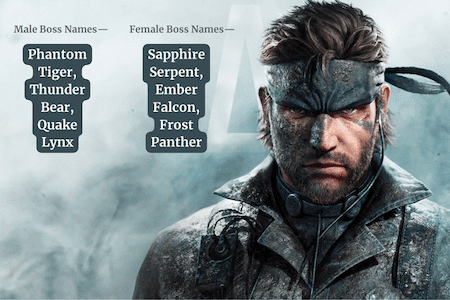
Beauty and the Beast Corps–Style Female Codenames
The B&B Corps from MGS4 — Laughing Octopus, Raging Raven, Crying Wolf, Screaming Mantis — uses a “[Active emotion in present participle] + [FOXHOUND animal]” formula. It’s a deliberate echo of the original FOXHOUND lineup, twisted by trauma. If you want to evoke MGS4’s gothic-tactical tone, look for results like:
- Bleeding Falcon
- Burning Cobra
- Whispering Lynx
- Drowning Hawk
Picking the Right Metal Gear Name Generator Result for Your Project
The Metal Gear Name Generator will surface a lot of options. Here is how to filter them down without overthinking it.
- Match the modifier to a real combat role. If your character is a sniper, “Sniper [Animal]” or “Silent [Animal]” lands. If they’re a CQC monster, lean into “Iron,” “Steel,” or “Vulcan.” Generic adjectives like “Bronze” or “Sterling” feel decorative — fine for a side character, weak for a protagonist.
- Pick an animal that maps to the character’s silhouette. Snakes for stealth, wolves for pack-hunters, ravens for survivors, octopi for shapeshifters and infiltrators, mantises for psychics, cobras for venomous specialists. The animal isn’t decoration — in Metal Gear, it’s a thesis statement.
- Say it out loud. Codenames in Metal Gear are radioed, shouted, whispered through CODEC. If the name is hard to pronounce or has too many syllables, it doesn’t function. “Phantom Tiger” works on the page and over comms. “Crystallized Pangolin” doesn’t.
- Avoid duplicating canon. Sniper Wolf, Solid Snake, and Quiet are taken. If a generated name is too close to an existing character, regenerate or swap one half. The point is to feel like a Metal Gear character, not to be confused with one.
- Pair the codename with a real name. In canon, every operative has a birth name and a codename: David / Solid Snake, Eli / Liquid Snake, Frances Cassidy / Sniper Wolf. If you’re writing fiction, generate the codename here and pair it with a realistic civilian name from a culture that fits the character’s backstory.
Where to Use Names from the Metal Gear Name Generator
The output is broadly useful, but a few specific use cases get the most out of it.
- Tabletop RPG characters. Operators in stealth-action systems like Spire, Blades in the Dark, or military-themed homebrew benefit from a Metal Gear–style codename layered over a normal name. Players remember “Vulcan Bear” longer than they remember “Sergeant Mike Davis.”
- Fan fiction and original fiction. If you’re writing Metal Gear fanfic, you need codenames that scan correctly. The Metal Gear Name Generator gives you naming output that fits the canon’s tone — saving you the hour of brainstorming that would otherwise produce names that sound off.
- Stealth-game character mods and milsim avatars. Whether you’re making a custom soldier in Ground Zeroes, building a milsim profile in Arma, or naming a private mercenary squad in any tactical sandbox, codenames that follow the FOXHOUND pattern carry instant credibility.
- Online handles and gamertags. Two-word codenames are short enough for most platforms and stand out from the sea of generic gamertags. Avoid anything offensive, obviously, and check availability before committing.
- Worldbuilding for original military fiction. Even outside Metal Gear, the FOXHOUND naming logic — animal + modifier — is one of the cleanest codename systems in fiction. Borrow the pattern, swap the animals if you want regional flavor, and you have a faction-naming convention in five minutes.
2026 Update — Metal Gear Name Generator Picks for Snake Eater Delta
Snake Eater Delta launched in August 2025 and pushed the Cobra Unit and the original Naked Snake / Boss timeline back into player consciousness. As of 2026, the most popular codename clusters on the rebooted side of the franchise lean Cobra — short, abstract, single-concept handles. If you’re writing or roleplaying in the Snake Eater era, prioritize Metal Gear Name Generator outputs that fit the pre-FOXHOUND aesthetic: less “tactical operator,” more “Cold War mythological warrior.”
Concretely, that means the Cobra Unit pattern outranks the Diamond Dogs pattern for this era. Single-concept handles like The Patience, The Hollow, and The Mercy fit the 1964-set tone. Animal-and-modifier names still work, but skew toward natural-world descriptors over industrial ones (Storm Wolf reads as Cobra-era; Vulcan Wolf reads as MGS1).
Additionally, Konami has hinted at continued investment in the franchise following Delta’s strong launch — over a million copies sold in 24 hours — so codename inventories are likely to grow. The generator’s word banks will be expanded to match new canonical material as it ships.
What Makes a Codename Feel Canon — and What Makes It Feel Off
Generators that ignore the underlying logic produce outputs like “Sapphire Serpent” or “Bronze Swan” — names that sound vaguely fantasy but have nothing to do with Metal Gear’s actual aesthetic. The reason those misfire is that Kojima’s codenames are functional, not decorative. Each one is shorthand for a combat role, a personality state, or a place in a chain of clones. Therefore, when you evaluate output from the Metal Gear Name Generator, you’re really asking one question: does this name encode information?
Specifically, the canon names you remember are the ones where the modifier reveals something about the character before they speak a single line. “Sniper Wolf” tells you she shoots from distance and hunts in patterns. “Psycho Mantis” tells you he reads minds and moves objects without touching them. “The End” tells you everything you need to know about an old man holding a sniper rifle and a cup of tea. By contrast, a name like “Bronze Eagle” reveals nothing — it’s pretty, but it’s empty.
Practically, the test is this: read the codename, then ask what role it implies. If you can describe the character’s loadout and combat style in a sentence based on the name alone, the name is working. If you can’t, regenerate. This single filter eliminates roughly 70% of weak output and leaves you with names that could plausibly appear on a Metal Gear character roster.
Frequently Asked Questions
Are the names from the Metal Gear Name Generator from the actual games?
No — and that’s intentional. The generator is built to produce new codenames in the style of Metal Gear, not to spit out canon characters. Specifically, the word banks were curated by analyzing the modifiers, animals, and emotions used across the FOXHOUND, Cobra Unit, Diamond Dogs, MSF, B&B Corps, and Snake lineage. Therefore, the outputs feel native to the franchise without duplicating real characters.
Can I use the generated names in published fiction or games?
Generally yes — short word combinations like “Iron Lynx” or “Phantom Falcon” aren’t trademarked or copyrighted in most jurisdictions. However, do not use the canon character names (Solid Snake, Sniper Wolf, Big Boss, Quiet, Skull Face) in commercial work, as those are owned by Konami. The generator is designed to avoid surfacing exact canon names, but always double-check by searching the result before publishing.
Why do all Metal Gear codenames pair an animal with another word?
The animal-plus-modifier pattern came directly from FOX, FOXHOUND’s predecessor unit. Kojima picked “Snake” specifically because it symbolized stealth and silent movement without committing to one species — leaving the player to project themselves into the role. Subsequent units (FOXHOUND, Diamond Dogs, the B&B Corps) extended that logic, turning each animal into a thumbnail for combat style.
What’s the difference between boss names and character names in this generator?
Boss names follow the cinematic FOXHOUND / B&B Corps pattern — heavy modifiers like “Phantom,” “Vulcan,” “Sniper,” “Hollow.” They’re built to carry a fight scene. Character names follow the soldier-tier Diamond Dogs pattern — shorter, more operational handles like “Wild Dog” or “Red Hawk,” meant to fit on a roster, not headline a cutscene. Pick boss for protagonists and antagonists; pick character for support cast and faction grunts.
Can I generate Cobra Unit–style “The [Word]” names directly?
The current build leans on the FOXHOUND and Diamond Dogs patterns by default. However, you can replicate the Cobra Unit style manually: generate a boss-tier name, drop the animal half, and prefix the modifier with “The.” For instance, Hollow Wolf becomes The Hollow; Phantom Falcon becomes The Phantom. It’s a one-second edit and produces some of the most memorable codenames in the franchise.
Does Metal Gear Solid Delta change which codename patterns are popular?
Yes. Since Delta’s 2025 launch, Cobra-era handles have surged in fan creations. The remake pulled Naked Snake, The Boss, and the original Cobra lineup back into focus, so single-concept “The [Word]” codenames feel especially current in 2026. If your project is set in the Snake Eater era, prioritize that pattern. For MGS1-era and beyond, FOXHOUND-style two-word codenames remain the default.
Related Generators on CalculatorWise
If you’re naming a wider cast — allies, rivals, civilians, or characters from adjacent franchises — these tools pair well with the Metal Gear Name Generator:
- Elden Ring Name Generator — for fantasy-style codenames with a darker, ritualistic edge
- Devil May Cry Name Generator — stylized, demon-hunter-style names with similar two-word structure
- Call Sign Generator — military-style aviator handles, useful for adjacent operators
- Borg Name Generator — sci-fi designation-style names if your faction has cybernetic operatives
- Random Genshin Character Generator — for crossover or anime-tactical builds
More Free Tools and Content You Might Love
We have a number of other fantasy name generators on this site, such as:
- The Hogwarts Legacy Name Generator for magical character names by house and gender 🪄
- The Random Pokemon Generator for getting any Pokemon and their stats in seconds!
- Dwarf Name Generator, perfect for any Dwarf character 🧙🏼
- The Dwarven City Name Generator, which helps you get realistic Dwarven city names ⛰️
- Hobbit Name Generator, which is excellent if you need authentic Hobbit names fast 🧝♂️
- The Mentor Name Generator, which is perfect for a mentor character 🔮
- The Dragonborn Name Generator if you need D&D-inspired names 🐉
- The Devil May Cry Name Generator if you’re a fan of the famous Devil May Cry series 🎮
- Finally, the Demon Name Generator is amazing for demon names 😈
- The Giant Name Generator is fantastic for getting names for any type of giant 🗿